Friday, February 08, 2008

Abstinence-Only Defies Voters’ Priorities

By Dr. Charles Jaynes and Margery Engel Loeb

A year ago, Governor Rick Perry showed great leadership when he issued an executive order requiring the state's sixth grade girls to get the HPV vaccine, to prevent cervical cancer. It was a bold move for a state that is conflicted about how best to prevent the spread of sexually transmitted diseases.

But, if Gov. Perry truly wants to stop the spread of STDs, he will change the state's policy that allows teaching abstinence-only sex education. Recent studies have revealed that an abstinence-only plan won't stop the spread of STDs or decrease the rates of teen pregnancy.

Texas teenagers lead the nation in birth rates, and, as new figures from the National Center for Health Statistics show, after 14 years of steady decline, teen pregnancy rates went up 3 percent across the country in 2006. To many public health officials and educators, the cause for the increases in pregnancy was apparent: since 1996 the only federal funding available to states for sex education is for "abstinence-only" curricula.

Meanwhile, not only have teen pregnancy rates gone up but so have instances of STDs. Lubbock, for example, for 10 years led the nation in the number of Chlamydia and gonorrhea infections, one-third of which came from 15 to 19 year olds. Sexually active teenagers are no longer provided with information on how to prevent pregnancy or the spread of STDs. A rash of studies have also shown that the programs do not succeed in stopping or even significantly delaying teen sex. Despite this, Congress extended funding for "abstinence-only" sex education for another six months.

But a growing number of states have drawn a line on continuing with "abstinence-only" sex education. This year alone 18 states chose to forgo federal funding, and send a message to Washington that we only want to spend our money on effective programs that really protect our children. Texas also needs to voice our concerns to Washington.

While Texas law offers the option of teaching an “abstinence plus” curriculum -- which would include some lessons on birth control -- few schools use this option because the federal dollars are restricted for the abstinence-only lessons, and the money for the “plus” part has to be raised separately.

The criteria for "abstinence-only" programs demand great sins of omission; the only means of pregnancy prevention taught is that of abstaining from sexual activity. Ditto for the prevention of sexually transmitted diseases.

Some of the lesson plans, in their zeal to support abstinence, actually disparage the usefulness of other form of protection, planning or prevention. We need to help our teens learn how to make responsible decisions by arming them with complete information that they will use for the rest of their lives.

Most parents agree it's simply unrealistic to believe that you can stop all teens from having sex by telling them "not to do it," especially when studies report that 60 to 70 percent of teens are sexually active by age 19. That's why 88 percent of voters, according to recent research commissioned by the Women Donors Network, together with Communications Consortium Media Center, agree that "comprehensive sex education should be taught in schools that includes information about abstinence, contraception, and how to avoid sexually transmitted diseases like HIV/AIDS." Eighty-one percent of voters surveyed support a much broader discussion on health issues.

The hard-core activists who push the abstinence-only agenda -- even in light of new evidence that it is not effective in reducing sexual activity, unwanted pregnancies and sexually transmitted infections -- comprise fewer than 10 percent of voters. Why should they alone get to make educational decisions that could have grave consequences for other people's children?

The reasonable majority of parents who want their children to receive an appropriate and informative form of sex education can no longer afford to stay silent on the issue. States are pushing for change because they would rather put money into programs that work, and not be forced by the federal government into funding unsuccessful plans.

It is crucial for parents to speak to their elected officials and school boards about the need for comprehensive health and sex education. If parents want their children to be presented with accurate health information so that they can make responsible choices about important life decisions -- like when to become a parent -- then that reasonable majority of parents needs to make themselves heard.
------------------------------------------------------------------------------
Jaynes is a practicing obstetrician gynecologist in Victoria, Texas. Loeb is a board member of the Women Donors Network and leads their project on reproductive and other health issues.

Learning Starts At Birth


By June St. Clair Atkinson and Stephanie Fanjul

To truly prevent the dropouts of tomorrow, our work begins at the very start: the day a child is born. Why? Because children are born learning, and if we wait until third or first grade or even kindergarten to pay attention to what they've missed, it's already late in the game.

Research tells us that at least half of the educational achievement gaps between poor and non-poor children already exist by the time they start kindergarten. A child's brain works on a "use it or lose it" principle, and synapses not stimulated early on will be discarded and more difficult to reconstruct later. Like starting five spaces behind the starting line, the bigger the gap when children start school the harder it becomes to close in the intervening years.

Recognizing this, North Carolina educators and policymakers had the foresight to launch Smart Start, an early child hood program and More at Four, a high-quality pre-k program that serves 4-year-old children who are at risk. The two programs work together to ensure that, from birth, children have the developmental opportunities they need to be successful in school. But now we need to go a step further.

We have brought together early childhood and school leaders, parents and communities to take this next step forward, launching the NC Ready Schools Initiative. This is part of a national initiative that focuses on the early years that span from age three to grade three.

Last June the State Board of Education adopted the Ready Schools definition and endorsed the recommendation that all elementary schools link with a community planning team to conduct a ready schools assessment as part of their School Improvement Planning process. It endorsed the North Carolina Association for the Education of Young Children "Power of K" position paper clarifying what kindergartens should be like -- not the pushed-down academic structures often resulting from the pressures of accountability and No Child Left Behind.

Research from states where Ready Schools' programs are further along shows that such programs are helping to increase reading scores significantly -- from 49 to 70 percent passing rates for African American first graders in Montgomery County, MD -- and to decrease proficiency gaps based on race and ethnicity. In addition, more careful consideration is going into who serves in a principal's role in the elementary grades. If that person does not have training in child development and the early years, pilot participants are providing professional development in those areas.

An emphasis on the crucial learning period from birth through the early grades can also help ensure the success of existing programs such as No Child Left Behind, which have a heavy focus on academics and accountability.
It is imperative for educators to understand that they can teach academic content in developmentally appropriate ways for young children. We also know, that as critical as pre-K for at-risk students is, without sustained focus and appropriate instruction, these children may experience "fade out" -- or a loss of learning gains -- by grade three. Thus, the notion of "book-ending" education -- focusing on children of high school age and very young children -- is important to our ultimate goal of success for all students.

North Carolinians can be proud of their history as educational innovators -- from opening the first public university in the nation to starting the first Governor's School to pioneering school-based accountability. But given all of this effort what can citizens make of the state's continual problem with school dropouts and a high school graduation rate that still shows approximately one-third of all ninth graders failing to graduate from high school within five years?

With the introduction of the NC Ready Schools Initiative, combined with our existing efforts through Smart Start and Governor Easley's More at Four Program to enhance early childhood education, North Carolina has an excellent chance of reversing those high school dropout numbers and continuing to reduce the achievement gap. We can't start soon enough -- because when it comes to educating North Carolina's children, this is one test we cannot afford to fail.
---------------------------------------------------------------------------
St. Clair Atkinson Ed.D., is the state superintendent of North Carolina. Fanjul is president of The North Carolina Partnership for Children, Inc.

Wednesday, February 06, 2008

What’s the Next Step for Health Care

By Lydia Pendley

There is a small window of opportunity for New Mexico to take the next important step toward real health care reform that will lead to a rational, affordable system of health coverage and health care for all people living in the state.

There is still time in the 2008 legislative session for action, if our legislators have the political will to create the infrastructure that will lead to a sound, evidence-based plan for health care for all by the longer 2009 legislative session.

The proposal to create a New Mexico Health Care Authority is an appropriate and well-thought out next step. The Health Care Authority would be charged with conducting policy analysis and creating evidence-based information about health care financing, delivery systems, and overseeing and implementing health care reform in New Mexico.

It would incorporate the Health Policy Commission staff expertise and would build on the initial cost comparison of three health coverage models completed last summer by Mathematica. It would be charged to develop by January 2009 an action plan for the legislature to consider that would achieve affordable, quality health care for all people living in New Mexico.

A Health Care Authority will be an effective means to real health care reform if it is created in a way that ensures:

  • It is independent from control of any single branch of government;

  • It is independent from control of health care industry financial interests;

  • It has no presupposition that health insurance reform is an appropriate strategy for health care reform; and

  • It is charged, through legislation, to address health care reform comprehensively, including provision of comprehensive benefits, funding mechanisms that assure affordability and cost containment, portability of coverage, consolidation of actuarial pools, impact of federal programs/regulations, transparency of health costs, health care data reporting and collection.
The authority must have the ability to address not only health coverage but also cost containment and how the delivery system can be accessible and provide quality care.

There are a variety of health care reform-related proposals before the legislature, and the debate and negotiation is intense with legislators, the governor, state government officials and advocates having a variety of opinions and supporting different options for getting us closer to health care for all New Mexicans.

The Health Care for All Campaign supports the creation of the New Mexico Health Care Authority as the best option to making progress toward real health care reform. We need to start with an entity that can work on these issues over the long term, independent from political or health care industry pressure and can draw on needed expertise from all sectors to develop, with strong public input, the best health care reform plan giving all people living in New Mexico access to affordable, quality health care.

The people of New Mexico must let their voices be heard. The state must provide a way forward with health care reform, out of the morass of political interests, confused messages and claims, and untested strategies for reform. Reform will not happen unless we raise our voices and demand that the broken system be fixed.
--------------------------------------------------------------------------------
Pendley is a member of the Health Care for All Campaign and the co-group leader of RESULTS-Santa Fe.

Monday, January 28, 2008

Stop Stalkers Before They Become Headlines

By Marianne Hill

She could have been my daughter, or my neighbor’s daughter. Carnesha Nelson was a bright, attractive 19-year-old college student who unfortunately became the obsession of a young man who worked on her campus. He hounded her and wouldn't take no for an answer. The night he assaulted her, she ran screaming from him, pounding on the doors of neighboring apartments. Residents called the police, but did not let her in. He caught and killed her.

January is stalking awareness month, an appropriate time to assess our treatment of stalkers, and unfortunately "awareness" is lacking. Most are not aware that stalking that ends in violence is not uncommon. Each year there are many young women who say no to boyfriends and suitors, and lose their lives as a result. Over 1,100 women were killed by intimate partners in 2005, and another 860 by male acquaintances, with women from 18 to 30 years old the most at risk. However the number of women killed by stalkers is only a fraction of those affected by the violence: over one million protective orders are issued annually by the states to protect women from assault or stalking. Stalking is a growing problem on college campuses where over 20 percent of college women report fearing for their safety as a result of being stalked, according to a 2004 study cited by the National Center for Victims of Crime.

The suffering inflicted by stalking is great. Fearing for their safety, victims will often move, change jobs, or drop out of college and training programs to elude their pursuers. If they rely instead on protective orders, they can expect to find an angry stalker taunting them at their home or workplace: over 69 percent of protective orders for women are violated, according to a 1996 Justice Department survey. At times the stalker is not even served with papers notifying him of the protective order, since budget priorities lie elsewhere. In many states, some victims cannot even apply for protective orders: teens under 18 years old or women who have never dated their stalkers may not have this legal recourse. These same women may also be ineligible for access to women's shelters.

The first anti-stalking law went into effect in 1990 in California, and such laws now exist in all the states. The states and several college campuses remain in the process of working out effective protocols for dealing with stalkers. Anti-stalking laws can be a strong deterrent to violence, but only if effectively enforced. In a few cases, a serious discussion with the stalker may be all that is needed. But persistent stalkers, who ignore court orders and pose a threat to the victim, must face certain arrest and jail time, if such stalking is to be stopped. However, only 44 percent of persons violating a protective order were arrested, according to the National Center for Victims of Crime.

Stronger protections for women who are stalked would save the lives of thousands of women, and would increase the security and well-being of the young adults on our college campuses. The funding of the necessary interventions should be a high priority.

A shift towards such a policy requires a change in national attitudes. Our communities will be better off when we get tough on stalkers: the young, good-looking college student or businessman who persistently stalks and threatens his ex-girlfriend with violence is a threat not only to her, but to her family, friends and co-workers and should serve time. Our legal system must in fact protect those whose only crime is to have chosen the wrong partner, or in some cases, simply to have become the obsession of the wrong person. The need is urgent. Without such protection, many more lives will be unnecessarily lost to violence, and millions of young adults will lack the safety and security they need to flourish.
-----------------------------------------------------------------------------
Hill is a Jackson economist and a founder and member of the Mississippi Coalition for Women.

Tuesday, January 08, 2008

Arnie Arnesen and her regular woman problem


photo © 2008
Talk Radio News Service

Arnie Arnesen interviews Elizabeth Kucinich on the Talk Radio News Service radio row.

MANCHESTER, N.H. -- Deborah "Arnie" Arnesen is a lot of things: attorney, television producer, radio talk show host. Recently named by The Nation magazine as one of the country's Most Valuable Progressives, Arnesen was also the first woman to run for governor in the state of New Hampshire. In 1992, while facing off against Republican Steve Merrill, to whom she lost by a hair, Arnesen also helped shepherd a young presidential candidate around the state. His name was Bill Clinton.

Arensen has been broadcasting her radio show, Political Chowder (WCCM 1110 AM in Southern New Hampshire), this week from the Talk Radio News Service radio row in Manchester, and I had the good fortune to get Arnie to sit down for an interview on primary night, in between interviews she was giving to media outlets as far flung as
Australian TV and Al Jazeera.

One of Arnesen's great concerns is that, when challenging people to transcend their prejudices, it is done strategically. To make her point, she told me this story:

[As the] first woman to run for governor of my state, I never talked about being a girl. I never did, because I said -- you know why? They notice. I walk into a room, and they see two breasts. So I don't ever have to explain to them who I am. What they have to do is process whether I'm a leader...

About a year into my campaign, it was 1992; I hadn't won the primary yet. So, I had just given a speech on the economy and what we needed to do to dealt with some of the economic issues facing our state. It was at a Rotary Club, so it was predominately male. A guy comes up to me and says, "That was the most economically sophisticated speech I have ever heard." He said, "I am absolutely blown away by you." And I'm thinking to myself, I'm not that good.

And then he looks at me and says, "But it's too bad that I can't vote for you." And I said, "Excuse me? Why?"

And then he gets a little red in the face and he says, "Well, it's because of that woman problem." And I just said, "What?"

And now he's getting really red in the face, and says, "Well you know -- that regular woman problem."

So I looked at him and I said, "How did you describe my speech again?" And he said, "You are obviously very bright, you obviously know your policy issues, and you are very funny and very smart."

And I said, "Let me tell you something. You know that regular woman problem? Well, I'm having it right now." And I said, "If I'm so good at this time of the month, imagine me during the rest of the month." And that was 1992.

Do you know how excited I am that we have a woman [running for president] who is never asked a question about her period? But I was.

You know, I told that story over and over on the campaign trail. Because I knew that for that one person who asked me, there were a lot of other people thinking the same thing. That guy gave me a gift. I used that story over and over...I used it to educate all the men in the room.


--Adele M. Stan

So You Think You Can Be President


Craig Greager and Iris Burnett, authors of So You Think You Can Be President?

MANCHESTER, N.H. -- Iris Burnett has a question for you: So You Think You Can Be President? That's the title of a soon-to-be-published book that Burnett co-wrote with Clay Greager. They're a bi-partisan team; Burnett has a long career in Democratic politics, while her co-author is a retired military man who identified as Republican for much of his life. The book was born out of an e-mail exchange between the two friends. Greager joked to Burnett that she should run for president; she retorted that she didn't think she could pass the test. "Is there a test?" Greager shot back. "No, but there should be," thought Burnett.

So the two, for their own amusement, according to Burnett, started devising questions they would like to see on such a test, and soon the two had a book's worth. Written in a light tone, the book is amazingly informative. "I think people don't have any idea of just how vast the federal government is," Burnett says. "There are 192 independent agencies, and they all need to be staffed [by the incoming president]."

One of the questions on Burnett's and Greager's test asks respondents to choose between a list of resources most useful upon winning office. One is "a discarded copy of the plum book." That's the best pick, says Burnett. "[The plum book is] a catalog of all the politically appointed positions. So after your candidate wins, you rush to buy the plum book because then you look in the plum book to find the job you want. Then they tell you you can't have that job, so you find another job. And eventually you wind up with a job."

Iris Burnett's career in government has ranged from communications strategy for campaigns to managing transition teams, ans working within government agencies. To date, she is the only woman to have served as security director for a national political convention: she ran security for the 1980 Democratic National Convention in New York City's Madison Square Garden. Asked how she got the job, she said Bill Dixon, who was staffing the convention, got to the end of his job list, and realized he had no women in key positions. And by 1980, the party was feeling the heat of the feminists. So, he gave the last job he had to fill to Iris Burnett. "But I've never done security," she told Dixon. "Are you saying you can't do the job?" Dixon goaded her. "Well, of course I can do the job, " she replied, and wound up coordinating contingents from law enforcement agencies ranging from the FBI to the New York City Police Department.

So, does she think she could be president? Maybe not. But now she can pass the test.

--Adele M. Stan

The View From Radio Row

photos © 2008 Talk Radio News Service

Laura Ingraham broadcasting from radio row in New Hampshire.


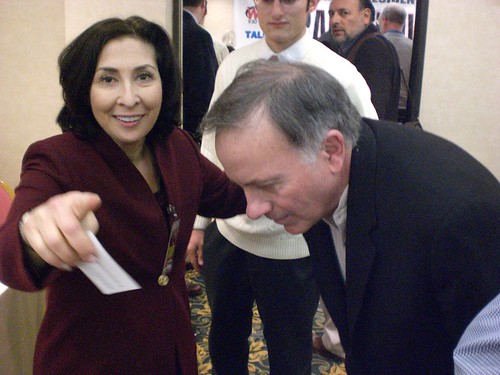
Ellen Ratner, founder of Talk Radio News Service (TRNS), and former presidential candidate Tom Tancredo.


Presidential candidate Mike Gravel. (NWEF's Adele Stan blogs in the background.)


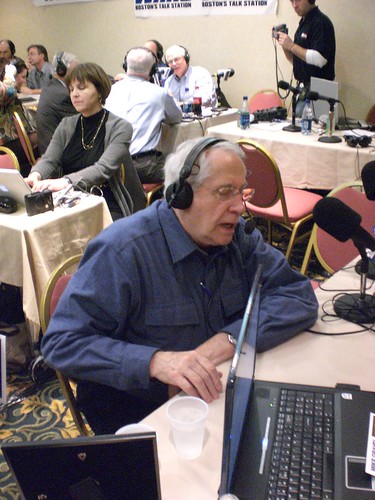
MANCHESTER, N.H. -- Thanks to our friends at Talk Radio News Service, the National Women's Editorial Forum has an inside view of the madness known as radio row here at the Center of New Hampshire Radisson Hotel, where the national and local media have all clustered for coverage of the first-in-the-nation presidential primary.

In two hotel meeting rooms talk radio hosts occupy tables laden with microphones and computers, and representatives from all the campaigns come and make the rounds. Behind me, right-wing radio host Laura Ingraham holds court. At the table next to hers, New Hampshire's own Arnie Arnesen receives her guests. Arnesen was just named as one of the nation's "most valuable progressives" by The Nation magazine.

This morning, the place experienced a major swarm of Hillary Clinton's surrogates, along with representatives from virtually all the presidential campaigns, Democrat and Republican. A few chairs down from me, David Bonior, the former congressman who chairs the John Edwards campaign, is giving an interview to University of New Mexico radio. Over in the corner, Republican candidate Ron Paul is being mobbed by both radio and television folks.

Me, I'm just trying to keep from getting knocked in the head with a mic or a television camera.

--Adele M. Stan

Investing to Re-Energize Ohio

By Amanda Woodrum

There is a gaping hole in Ohio’s economy. At current energy prices, we are sending nearly $20 billion every year out of Ohio and out of our country in order to purchase two-thirds of our coal, 89 percent of our natural gas, and 98 percent of the oil and petroleum products we use.

We currently rank fourth among states for industrial energy use and sixth for total energy consumption. To make our economy more energy independent and reduce our need to purchase expensive and polluting fuels, we should expand Ohio’s clean energy fund. This will allow us to become more energy efficient and to replace some of our polluting energy sources with renewable energy resources such as wind, solar, and biomass, which can be produced domestically.

Eighteen states and District of Columbia are together spending nearly $2 billion for clean energy to help break down existing market barriers to energy efficiency and renewable energy products and services. Why? Because each dollar invested in renewable energy and energy efficiency creates more manufacturing, construction, retail, and service jobs than an equivalent dollar spent on conventional energy. And every public dollar spent for clean energy leverages an additional $3 in related business and consumer investment, according to the American Council for an Energy Efficient Economy.

These clean energy funds, including Ohio’s Advanced Energy Fund, are used to reduce equipment costs for clean energy products through consumer rebates, grants, and low-interest loans; to conduct statewide public-awareness campaigns; to provide incentives for industrial production of clean energy products; and to train workers for the green economy.

Clean energy funds, across the 18 states, range from $2.3 million to $440 million per year. Ohio is near the bottom of that pack. Other industrial states collect more money than Ohio annually in order to jumpstart their economies, Michigan over $66 million, New York $175 million, and Wisconsin over $82 million. Pennsylvania’s governor proposed an $850 million Energy Independence Fund.

The state of Ohio currently collects $5 million each year, through a nine cent surcharge on Ohio electric utility bills, to spend on clean energy projects and services. Compared to the $20 billion we spend on conventional energy purchased from other states and other countries, $5 million seems almost trivial.

The public benefits funds we have spent thus far on clean energy in Ohio indicate the potential for much more far-reaching gains. A little over $5 million in public fund expenditures from Advanced Energy Funds leveraged an additional $21 million in outside investment. Ohio consumers are eagerly using clean energy funds to invest in energy efficiency, solar power, wind power, and biomass equipment. Recently, $5 million in grant funding was also allocated to aid in the creation of two large-scale wind farms to help provide electricity to 45,000 Ohioans.

Ohio’s Advanced Energy Fund should be expanded, made permanent, and used to encourage both the supply of and demand in Ohio for energy efficiency improvements and renewable energy systems. A $0.003 per kilowatt-hour surcharge on energy use, or three-tenths of a cent for every 1000 watts consumed for an hour, would generate an annual fund of over $465 million. To the average residential consumer this would mean a $2.80 increase in their monthly electric utility bill.

A greatly expanded clean energy fund in Ohio could be used to implement a statewide outreach campaign to educate the public on their energy efficiency and renewable energy options, and to provide free energy audits to Ohioans and simple customer rebates for green products such as solar panels. We can also expand Ohio’s clean energy supply chain by providing financial support to potential suppliers of green energy products and services to retool their infrastructure and retrain their workers. We could create a Green Jobs Corps program to provide green employment services and weave together vocational skills training programs, union apprenticeship programs, and recognized pre-apprenticeship programs that create pathways out of poverty.

It’s time for Ohio to get serious about investing in a clean energy economy by creating a strong Advanced Energy Fund.
--------------------------------------------------------------------------------
Woodrum is the Policy Liaison at Policy Matters Ohio, a non-partisan policy research institute. Her recent report on Ohio’s Advanced Energy Fund is on the web at www.policymattersohio.org.

Thursday, January 03, 2008

Three Reasons to Oppose Cliffside Expansion

By Alice Loyd

What should North Carolina do in response to the growing effects of global climate change, a statewide health advisory on mercury tainted fish, and an exceptionally serious statewide drought? Apparently the answer for Duke Energy and state regulators is to build a new massive carbon dioxide spewing, mercury emitting, and water-depleting coal burning power plant just west of Charlotte. If built, this 800-megawatt coal-fired unit at Duke’s Cliffside power plant will be the largest coal burning unit ever built in North Carolina.

The answer for people who practice what they preach about environmental responsibility is quite different. These people work for a new energy economy in which officials would not permit Duke to build this proposed coal plant. Here are just three of the reasons not to build:

THE DROUGHT: North Carolina is currently under a severe statewide drought and Governor Easley is urging residents to find creative ways to conserve water. But what isn’t often mentioned is that coal and nuclear power plants are some of the state’s biggest water hogs. If the Cliffside unit is built, it would double the amount of water lost to evaporation at the Duke plant from 10 million to about 20 million gallons -- each day.

To put that number in perspective, the additional 10 million gallons of lost water would be equivalent to the combined water consumption on one day this November by the cities of Lexington, Boone, Nashville, Goldsboro, and Brevard.

The drought is serious enough that Duke and Progress Energy have begun looking at contingency plans in the event there isn’t enough water to run their coal and nuclear plants. Here’s a plan for Duke and Progress: invest in renewable sources of energy like solar and wind power, which are drought-proof.

CLIMATE CHANGE: Duke Energy’s plan for more coal comes just as the overwhelming scientific evidence points to humanity’s impact on global climate change. If built, the new Cliffside unit will annually emit over 6 million tons of carbon dioxide, one of the leading factors in global warming.

State regulators in Washington soundly rejected a plan for a 793 mega-watt coal plant this November because of their concerns about the plant’s emissions. This ruling followed similar recent decisions to halt coal plants in Florida, Kansas, Minnesota, Oklahoma and Texas. These states understand that the addiction to coal power must be kicked. Why doesn’t North Carolina?

MERCURY TAINTED FISH: Coal fired power plants are also the number one source of mercury emissions in North Carolina. Those emissions eventually fall into our waterways and make their way up the fish food chain.

Coincidentally, the state Department of Public Health has issued its largest ever fish consumption advisory based on unsafe levels of mercury found in fish consumed by North Carolinians. Most women and children are urged to avoid eating 22 types of fish due to high levels of mercury contamination. Mercury is particularly dangerous for women of child-bearing age because of the potential for harm to a developing fetus. Unsafe levels of mercury can lead to developmental disabilities and other adverse health effects. Burning more coal in North Carolina will only increase the mercury health risks for mothers and their babies.

In today’s world of technological advances in clean and renewable energy, it is irresponsible to commit this state to decades more coal pollution. Who will take responsibility and protect the people of North Carolina?

Perhaps state regulators at the Division of Air Quality will deny the permit Duke needs before beginning construction of the plant. Perhaps state legislators will pass legislation halting new coal power plants in North Carolina while the state studies the impact of global warming and the drought. Perhaps Governor Easley will use the power of the Governor’s mansion and follow the lead of Kansas Governor Kathleen Sebelius. She wrote the following after Kansas regulators denied a request for a new coal plant in October:
Of all the duties and responsibilities entrusted to me as governor, none is greater than my obligation to protect the health and well-being of the people of Kansas…Instead of building two new coal plants, which would produce 11 million new tons of carbon dioxide each year, I support pursuing other, more promising energy and economic development alternatives.
That sounds like real leadership. North Carolina needs our state’s decision makers to stand up for the public good and break our addiction to dirty energy by saying no to Duke Energy’s plans to expand their Cliffside coal plant.
--------------------------------------------------------------------------------
Loyd is the director of North Carolina Interfaith Power & Light, a project of the North Carolina Council of Churches.

Wednesday, December 26, 2007

The Jamie Lynn Spears Generation

By Cristina Page

(Click here to listen to a Public Service Announcement distributed by American Forum on the effects of abstinence-only education and the rise of premature parenthood and pregnancy rates among teenagers.)


The Spears family can't be shocked by much these days, not with Britney in every tabloid. Still the recent news seemed to unsettle them. Their 16-year-old daughter Jamie Lynn is pregnant. And while no bad news is unprofitable for the Spears (it is rumored Jamie Lynn, a TV star in her own right, was paid one million dollars to break the news in OK! Magazine), this particular note of fame does appear to have taken the family aback. ("I was in shock. I mean, this is my 16-year-old baby," her mother told OK!) It seems that no matter how well-to-do, (or bizarre) the family, it's always a tragedy to have one's child's adolescence taken away by pregnancy. While Jamie Lynn Spears is not your average teen, her situation is becoming a more common experience for many girls of her generation: premature parenthood.

A Center for Disease Control (CDC) report released this month reveals that in 2006 there was a dramatic rise in teen births among 15 to 19 year olds in the United States bringing to a grinding halt a steady 14-year decline. In fact, Jamie Lynn's situation exemplifies a reversal of many positive trends that began in the 1990s. Specifically there was a steep drop in abortion and unwanted pregnancy rates. During this period even sexual activity among high school students declined significantly. And those teens who were having sex -- as would an average of half of them would before graduating high school - were more likely to use protection.

Now these gains are slowing or reversing. Sadly, these reversals seemed inevitable. After all, since 2000 we have turned away from using every strategy that the previous decade proved effective.

Today's teens are the victims of a one billion dollar social experiment: The national implementation of the abstinence until marriage policy. Like the "Just Say No" to drugs campaigns of the Reagan years, it too has been a colossal failure.

Abstinence-only programs have not only failed to convince kids not to have sex, but have led many not to use contraception. To scare teens away from sexual activity, abstinence-only programs focus on the dangers of sex. If contraception is ever mentioned it is to highlight (and exaggerate) its failure rates. If a girl is told that even if her boyfriend uses a condom she'll get pregnant once every seven times -- as the popular abstinence program "Choosing the Best Way" instructs -- the incentive to use one dissipates.

Those promoting abstinence-only, mainly religious political groups, say parents should have the right to teach children according to their beliefs. What the same groups fail to mention is that the vast majority of parents -- 93 percent according to a 2004 Kaiser Family Foundation poll -- want their teens taught comprehensive sex ed, including accurate information about protection from pregnancy and disease. If there is a prevailing belief among parents it is decidedly anti-abstinence-only education. They're in good company too: All mainstream organizations of health professionals that deal with young people strongly criticize federal support for current abstinence programs. These include the American Public Health Association, the American Medical Association, the American Academy of Pediatrics, the American Psychological Association, and the Society for Adolescent Medicine. Last month 10 of the top experts in the fields of adolescent sexual and reproductive health advised Congress to completely de-fund abstinence-only programs because they withhold "potentially life-saving information from youth."

The toll of withholding potentially life-saving information is becoming tragically evident. In the states where the abstinence-only approach is more likely to be used disease is up. School districts in the South are five times more likely than in the Northeast to teach only abstinence. Today, the southern states have the highest rate of new HIV/AIDS infections, the highest rate of STDs, as well as the highest rate of teen births. While over the last decade other regions have made major strides in decreasing or stagnating HIV infection rates, according to the CDC the South accounts for 45 percent of all new cases.

Many states are realizing that instilling ignorance about sex and protection in our teens is the real moral violation. Teens need accurate information in order to make important life decisions. That is why, to date, 15 states have refused federal money for abstinence-only funding. Parents in the remaining 35 states must demand that their governors and statehouses reject federal grants for these ineffective and dangerous programs too. It's the only time just saying no might actually work.
----------------------------------------------------------------
Page is the author of How the Pro-Choice Movement Saved America: Freedom, Politics and the War on Sex and spokesperson for BirthControlWatch.org

Friday, November 09, 2007

Activists Rally for a Better Media...Video footage


Following up on Liisa’s recent post on the October 31st Free Press Rally outside the FCC Building in Washington, DC about media consolidation here is a video that features clips and key points made by guest speakers at the rally that I filmed and edited. While the FCC held hearings in the boardroom activists poured their hearts out, raising up their voices against monopolization of media.

First up in this video we have a clip of the Prometheus Radio Project “FCC Cheerleaders.” Dressed in blue and white uniforms with FCC stitched across their chests and armed with pom-poms the cheerleaders pumped the crowd up with a cheer about the FCC, finishing with a tough looking pyramid.
The rally also featured many powerful speakers who all had a say about how “big media” is damaging the diversity within the media.

Kim Gandy (President, National Organization for Women), Carol Jenkins (President, Women’s Media Center) and E. Faye Williams (President, National Congress of Black Women) all talked about the way consolidation affects women in the media, especially how it determines the role of ownership and higher positions held by women.

Wade Henderson (President, Leadership Council on Civil Rights) made the point that this was a civil rights issue because media consolidation goes against the rights of all people, not just people of color and women. Reverend Jesse Jackson (President, PUSH Rainbow Coalition) also spoke at the rally and he mentions that “big media” makes us lose hindsight of what’s really going on around us citing the Jena 6 case as an example.

Also in this video Rosa Clementè (REACHip-Hop) and Reverend James Coleman (President, Missionary Ministers Conference of DC) both spoke about the misrepresentation of people of color by the media.

All of these speakers had something interesting to say about media consolidation whether it was statistics, anecdotes, words of encouragement and outrage against the FCC.

-- Cristal A. Pinnix

The writer is an intern with American Forum and a student at Franklin Pierce University.


Tuesday, November 06, 2007

Protecting Older Women Against Cervical Cancer

By Susan Scanlan

(Click here to listen to a brief Public Service announcement distributed by American Forum. It is written by Op-Ed author Susan Scanlan and is advising for policy that promotes protection for older women from HPV.)


Much discussion recently has focused on a new vaccine that helps protect girls and young women against cervical cancer. The vaccine wards off the virus – the human papillomavirus, or HPV – that causes the disease. This medical breakthrough, however, does not protect against all cancer-causing HPV types and is only FDA-approved for girls and women aged 9-26. Therefore, it certainly won’t help women aged 65 and older, who account for nearly 20 percent of all new cervical cancer cases in the United States and more than 35 percent of all deaths from the disease.

Another technology -- a DNA test for HPV -- can better protect these women. And now, a proposal before Congress will ensure that older women get access to this test by requiring Medicare to pay for it.

This year, 11,150 women in the United States will be diagnosed with cervical cancer and 3,670 women will die of the disease, according to the American Cancer Society. Many more thousands of women will be treated for high-grade pre-cancerous lesions in their cervixes, undergoing procedures that are uncomfortable, anxiety-producing and expensive.

Widespread screening programs using the pap test have produced significant reductions in cervical cancer rates in the U.S. The pap test helps detect cellular changes caused by HPV infection. The pap test alone, however, is 51 percent to 85 percent accurate, depending upon the type of test used.

An HPV test is approved by the FDA for use, in conjunction with a pap test, in women aged 30 and older. HPV testing identifies women who are infected with “high-risk” types of HPV that could potentially lead to cervical cancer. When used with a pap test in women aged 30 and older, an HPV test increases to nearly 100 percent a clinician’s ability to identify women who have the risk factor for cervical cancer and thus require more diligent follow-up as long as the virus persists.

Knowing if a woman aged 65 or older has HPV could help determine if and how often she should continue to be screened. Multiple studies have suggested that incorporating HPV testing into screening programs, per established medical guidelines, improves outcomes while being more cost-effective than those programs without HPV testing.

Ultimately, of course, it is up to clinicians to decide which tests are most appropriate for their patients. But if Medicare covers HPV testing, clinicians will have more options to help prevent older women from developing cervical cancer.

HPV testing is included in cervical cancer screening guidelines from the American College of Obstetricians and Gynecologists, the American Cancer Society, the Association of Reproductive Health Professionals, the American Medical Women’s Association and the National Association of Nurse Practitioners in Women’s Health. Most private insurance companies and state Medicaid programs already cover HPV testing as part of routine cervical cancer screening for women aged 30 and older.

By requiring Medicare to cover this advanced prevention technique, older women can be assured of access to the same level of healthcare that younger women currently receive. And this can help to better protect all women from cervical cancer.
-----------------------------------------------------------------------------
Scanlan is chair of the National Council of Women’s Organizations, a nonpartisan, nonprofit coalition of more than 210 women's organizations across the nation collectively representing over 11 million women.

Friday, November 02, 2007

Keep local media alive!
Activists rally to protest FCC’s corporate tilt

Outside the headquarters of the Federal Communications Commission (FCC) in Washington, D.C., a group of 200 people gathered on Wednesday morning, in an effort to bring public awareness and persuade the FCC to change its direction on media ownership. The rally, sponsored by Free Press, Inc., a non-profit that works to limit media consolidation, was held in conjunction with a public hearing – announced by FCC Chairman Kevin Martin just five days ahead of the hearing date -- on how media consolidation affects local markets. Free Press organizing materials suggested that the short notice was an attempt to lock the public out of the debate.

The Washington Post described the media ownership issue this way:

FCC rules govern how many radio and television stations a company can own in a city and how many radio stations a company can own nationally. They also prevent one company from owning both a newspaper and a TV station in the same city, a rule likely to be lifted during the current review.
The rally featured many prominent speakers, such as the Rev. Jesse Jackson, president of the Rainbow PUSH Coalition, Kim Gandy, president of the National Organization for Women (NOW), Melanie Campbell, president of the National Project on Black Civic Participation, NAACP Director Hilary Shelton, Rev. Lennox Yearwood of the Hip-Hop Caucus, Rosa Clemente of REACH Hip-Hop and many others. They came together to speak about the possible negative results from the pending changes in FCC rules that would grant giant media corporations a much larger foothold in such local media markets as Washington, D.C.’s. Speakers argued that by indirectly forcing local Washington media outlets to close, the diversity reflected in local coverage – especially representation of people of color and women in local media – would likely be destroyed.

Ownership = content

A common argument in each speech was that whoever owns the media controls the content of media. Women own only 5 percent of television and 6 percent of radio, while minorities own 3 percent of television and less than 8 percent of radio. With their numbers so low in the seats of real power, it’s easy to see why members of these constituencies find perspectives not being presented in corporate-controlled media.

No matter the race or gender of its originator, the same narrative gets retold in media outlets nationwide when only a few hold the reins of media power; new ideas and alternative views do not get heard. This is important because if only one view is presented then the people will not hear the complete story. How well does a person make a decision when he or she does not know all of the facts?

One of the major problems with big corporations controlling nearly all major media is that they are more focused on ratings and money, rather than the story. Rev. Jesse Jackson pointed out that the Jena 6 story was originally ignored by the media. The only way the rest of the country learned of it was from local papers, blogging, and YouTube. Only then did the mass media pay attention to the news. As many of the speakers agreed, no social issue can be solved if the message doesn’t get out.

My Hip-Hop isn't your Hip-Hop

While many speakers focused on broadcast news, Rosa Clemente, a Hip-Hop activist spoke about the record industry. Definitely one of the more powerful speakers, Clemente pointed out that Hip-Hop is the culture of oppressed African- and Latin-Americans. However, the Hip-Hop she speaks of is not what is being played on the radio waves. This music does not mention social issues that are affecting the culture it represents, she asserted, partly because of the decisions made by record executives. It is a "fifty-plus-year-old white man" who controls the current Hip-Hop industry and creates the negative images of women and minorities, Clemente asserted. "The same white man," Clemente pointed out, "that in a meeting four weeks later said to us, 'I don’t let my kids listen to that music,' and we said to him, 'but it’s okay for you to be a multi-millionaire in Indiana and let my child listen to it?'"

The organizations taking part in the rally also included the Leadership Conference on Civil Rights, the United Brotherhood of Teamsters, United Church of Christ, Communication Workers of America, Consumers Union, Prometheus Radio Project, USPIRG, National Congress of Black Women, League of United Latin American Citizens, Women’s Media Center, Alliance for Community Media and Common Cause. The women of Code Pink were there, as well. They sang a parody about Rupert Murdoch and big media to the tune of "There’s No Business Like Show Business."

Interestingly enough, in my Understanding Mass Media class, I just finished a group project about media ownership. Each group had a magazine that they had to research in order to find the corporations that owned it. Presentation after presentation students noticed that it was the same companies who controlled the magazine industry, as well as television and radio. Common names were Disney/ABC, Hearst Corporation, News Corporation, and NBC/GE. It was easy to see how there was a lack of original news because it was all being recycled.

Debating what we already know

While my class has now been convinced that the media is run by a select few, the debate still went on inside the FCC building. The hearing did feature a panel of speakers, most of whom favor local ownership of individual television and radio stations. Each speaker was allowed five minutes to speak. Andrew Jay Schwartzman, president and CEO of Media Access Project, pointed out that 2,000 radio stations receive broadcasts from Viacom. "What’s the diversity in that?"

Rev. Jesse Jackson stated that although D.C. is a very racially and ethnically diverse city, there is not a single station that is minority-owned. Furthermore, he stated that Don Imus was on the air in more media outlets than the combined numbers of all radio hosts who are minorities and women. Dan Isett, director of corporate and government affairs for the Parents Television Council, gave an example of how big corporations ignore rules and regulations set by the FCC. He said that CBS allowed profanity to be aired during the day, claiming they thought their contract dealt only with live broadcasts, when CBS executives should have known the exact terms of their contract since the network’s lawyer had negotiated it with the FCC.

Although some may not think that we have to worry about our media being completely run by a few major corporations, or even by one or two people, I think that it is something that should be taken seriously. The media is very influential and powerful. As Rev. Lennox Yearwood said, in war the army destroys the media first. If only a few are controlling the media it is very possible that it could affect others’ viewpoints and how the country is run. In order for a democracy to be effective it needs all of the people’s voices to be heard.

--Liisa Rajala

The writer is an intern with American Forum and a student at American University.

Monday, October 29, 2007

No Exceptions: Give Rape Victims Emergency Contraception

By Wendy Wolf and Cathy Raphael

(Click here to listen to a brief Public Service announcement distributed by American Forum. It was written by authors Wendy Wolf and Cathy Raphael on the importance of emergency contraception in emergency rooms.)


A victim of a violent assault arrives in an emergency room. Once the patient’s condition is assessed, it is determined that the patient has, on file with the hospital, an order called an “advance directive” – instructions by the patient on what measures the hospital should take to prolong the patient’s life in the event of a catastrophic illness or injury.

Most Americans agree that all of us deserve the opportunity to make such decisions, within the bounds of the law, without interference from meddling politicians or hospital administrators. Dictates of someone else’s religion or conscience should have no bearing, most agree, on whether or not our wishes are carried out about such end-of-life measures as respirators and resuscitation.

Now imagine that patient, that victim of assault, as a woman who has been raped. By law, the hospital has to honor her wishes on how she would wish to die. But what about how she may wish to live? Should that same hospital be permitted to so meddle in her personal and moral life as to withhold from her the means by which she could prevent the pregnancy that might result from her assault?

Last week, the Independent Regulatory Review Commission approved new regulations that would allow health care facilities with religious affiliations or moral objections to claim an exemption from an otherwise laudable new rule that requires hospitals to inform rape victims of their right to emergency contraception, and to provide the contraceptive pills to the raped woman if she wants them. The new rule was handed down just as legislators were scheduled to take up a bill that would have required Pennsylvania hospitals and health care facilities essentially to offer the same, but without a so-called “conscience clause.”

With the new rule, state regulators have apparently appeased opponents to the proposed legislation who want to allow facilities to withhold birth control -- even from rape victims -- based on theological or moral grounds. Others seek to muddy the waters by claiming that emergency birth control is something it’s not. (Emergency birth control is nothing more than two birth control pills combined. It does not terminate a pregnancy; it prevents one from happening.)

Regulators have tried to mollify advocates for the rights of rape victims by requiring health care facilities that claim a “conscience” objection from the contraception rule to provide transportation for rape victims to facilities where emergency contraception is dispensed.

This is hardly compassionate care; it is a form of moral condemnation that may, in the end, result in what would have been a preventable pregnancy. Any time wasted by the withholding of appropriate medical care -- in this case, emergency contraception -- further increases the victim’s risk of becoming pregnant by her rapist. In some areas, the only hospital within hundreds of miles may be one that refuses full medical care to rape victims.

We know we’re not alone in our understanding as American citizens that each of us, as individuals, has a right to make important life decisions, within the bounds of the law, according to the dictates of our own consciences. Indeed, we at the Women Donors Network, together with Communications Consortium Media Center, recently conducted research among voters nationwide, surveying attitudes on important life decisions. We found very strong support for the idea that people’s individual decisions deserve respect. An overwhelming majority -- 83 percent -- told researchers that they agreed with this statement: “We need to respect people’s ability to make their own life decisions and not impose our values and views upon them.” Eight in 10 voters -- 81 percent -- agreed that they “may have on position on abortion, another on birth control and still a third on end-of-life decisions” and that “sometimes we must just agree to disagree.”

Our research found that Americans value personal responsibility -- taking charge of one’s life and family and helping to make the world a better place. Voters affirm respect, protection, prevention and planning as values in this discussion. People believe that important life decisions can only be made responsibly if they have access to information and options. Women who come to the emergency room after having been sexually assaulted deserve the information they need to make an important life decision about whether to become a parent or not as a result of being raped. It’s time for Pennsylvania to ensure that the full range of health care is available to all women who come through the emergency room doors for treatment after rape -- without any religious exemptions.

-----------------------------------------------------------------------------
Wolf leads the Women Donors Network project on reproductive and other health issues. Raphael is a Women Donors Network board member who is involved in the project.

Friday, October 26, 2007

Look Who’s Cheering Now

There’s always that one person at work or in class who can tell you everything you could ever want to know about sports. They know how many homeruns San Diego Padres left fielder Barry Bonds hit this season, the number of strikeouts thrown by Red Sox pitcher Josh Beckett and that Ricky Henderson holds the career stolen bases record. And by the way, these are your female colleagues. That’s right, we’re taking over. From Wrigley Field to Dodger Stadium, female baseball fans can be found cheering and jeering along with the best of ‘em. Make-up has given way to face paint and jerseys have become fashion statements. It’s not just about how cute Cleveland Indians centerfielder Grady Sizemore is -- although it doesn’t hurt -- or how Yankee short stop Derek Jeter looks in his uniform. These are serious fans who know the game and the players. With the 2007 World Series underway, baseball season is at its peak.

Baseball merchandising companies are also recognizing this boom among women. The Boston Red Sox are perhaps the baseball team seeing the greatest surge in female fans. Many now sell “fitted” t-shirts and pink hats as a marketing strategy. Fitted tees I’m cool with. My personal favorite, available to men also, says “I Do It With My Sox On.” The pink hat however, a different story. Pink has long been a synonym for little girl. Despite the fact that I’m an opponent of the color in general, I don’t appreciate it that some merchandisers believe this is the only color for women. I thought the Babe’s Curse was bad, but this pink hat thing really bothers me. For the most part, retailers like the Yawkey Way Store and Chowdaheadz have an awesome selection for females. I guess it’s just a personal preference. I’m sorry that I don’t want the famous Boston Red Sox font in baby soft pink on a white tank top. I want a Jason Varitek jersey, maybe slightly fitted, in navy and red. I’m all for making baseball more female-friendly, but let’s not make it girlish. Wear the team colors proud and don the same gear as the guys with Dice-K painted on their beer bellies.

Aside from my beef with the hat situation, the good news is that the general New England area has seen such a tremendous increase in female sports enthusiasm. Sasha Talcott of The Boston Globe wrote an interesting article about how merchandisers and ballparks plan to continue appealing towards women.
As women flock to games, the Patriots and Red Sox are looking for ways to encourage them to make it a long-term habit. The Red Sox are considering giving them special access to the ballpark on certain nights, including the chance to take batting practice on the field and to listen to sports speakers. The Patriots have focused on making Gillette Stadium friendly to families, which increases its appeal to women, team officials said.
Femmefan.com is one of the greatest web sites developed in the past several years. Its Cosmopolitan meets ESPN. You can find everything from locker room gossip to stats. Although baseball is my soft spot, the web site offers articles on all sports from basketball to racing. Feel-good pieces in sections like Here Me Roar feature witty commentary mixed with feminism and sex appeal in a series of articles telling what it would be like if women ran the NFL. Maybe one day we will.

It’s good to see another area where females are in the forefront, but ladies do me a favor and leave the pink hats at home.

--Ashlie McEachern

Thursday, October 25, 2007

What Girls Say About Self-Esteem

Last Wednesday I attended a presentation called “What Girls Say,” about self esteem, body image and holistic health. Sponsored by Girl Scouts of the USA and Women’s Policy, Inc., it had representatives, researchers, and a panel of girls explain the increasing pressure on young girls today and what the public and legislature can do to alleviate it.

With iPods, TV, movies etc, young women are constantly in touch with the media, so it’s no surprise that the body image issue is on the rise. As the presentation pointed out, media strongly influence girls, consciously and subconsciously, and sexual images on television are being seen by younger and younger viewers. These messages are stressing girls to become more appealing to boys. “Do we want our girls to be Bratz girls?” Rep. Debbie Wasserman asked, alluding to the scantly dressed, stereotypical “girl power” dolls geared towards preteens.

Being 18, I grew up with a generation of girls who were eager to do just that: grow up. I was about 8-years old when Britney Spears came out with her first hit “Baby, Hit Me One More Time.” Playing with dolls was a thing of the past and dancing with mini skirts and a short tee was considered cool. My mother was surprised by how fast I and the other girls my age were growing up, but at the time I thought nothing of it. Now that I’m older, I look back and realize how in some ways I did grow up fast and other girls are too. I and the rest of the audience were shocked when Rep. Wasserman shared a story concerning her 8-year-old daughter. One day she tried on a pair of pants and asked her mother “Do these make me look fat?”

Another problem is that there is a lot of pressure for young girls to succeed in every aspect. “[There is the] pressure to be everything to everyone all the time,” explained Judy Shoenberg, Director of Research and Outreach at the Girl Scout Research Institute. However, girls are more concerned with “fitting in,” finding a group of friends to which they feel that they belong. In the research at the Girl Scout Research Institute, most of the girls who were surveyed admitted that their number one worry was what their peers thought of them. It is because of this fear, that at a time when girls should be able to trust one another, they are often bullied and sometimes respond by bulling others. Kimberlee Salmond, Senior Researcher for Research & Outcomes and the Girl Scout Research Institute, warned the room that “Parents shouldn’t brush [the bullying] off. It truly affects the girls and their parents should talk to them.”

I found girls to be especially brutal in middle school. While many girls were teased because of their weight gain, I was constantly picked apart for my small, skinny bone structure. Even by my friends I was nicknamed “Stick.” Luckily, as I grew older the teasing subsided. For whatever reason, people dropped “Stick” and matured, becoming interested in more serious issues. It was because of the bullying that I had cared so much about my body image. When the bullying subsided I focused less on how I looked because I wasn’t constantly being reminded of it. Due to my experience, I was surprised by the fact that women became more focused on their body image in high school, college, and even later on in life. When I asked Shoenberg and Salmond about this they pointed out that it is different for everyone. While I had my mother to spill out my feelings and frustrations to, other girls do not have someone to confide in. If they don’t build confidence or become comfortable with their body image then it only gets worse. As Salmond explained, “It gets bad in college because [the issue] never goes away.”

Organizations like Girl Scouts help girls feel better about themselves physically and emotionally. When asked whether they had been a member of or involved in Girl Scouts, most of the female attendees raised their hands. Although I was never a member of an organization like Girl Scouts, after seeing so many powerful women who were influenced by it, perhaps more of these kinds of organizations can help girls who need that support while growing up. Someday these girls could be the women that were sitting in that room, all they need is someone to talk to. Looking back I really owe my mom a lot for always being there for me, it was because of her that I’m on my way to leading a successful and less stressful life. As for Rep. Wasserman’s daughter, I’m sure that despite the media and the pressure she too will turn out alright. How can she not with a mother who rushes out to fly back and help with the troop’s scrapbooks?

--Liisa Rajala

Wednesday, October 17, 2007

Fixing Cocaine Sentencing Laws

By Kara Gotsch

This month the Supreme Court heard a case which touched on a 20-year-old controversy involving justice and crack cocaine. The court will rule early next year in Kimbrough v. United States whether a federal district judge’s more lenient sentencing decision, based on his disagreement with policy that punishes crimes involving crack cocaine more harshly than those involving powder cocaine, is reasonable. The case will help judges determine their ability to sentence below an advisory guideline range. Unfortunately, the outcome will leave in place the excessive mandatory penalties that the Kimbrough judge found unjust.

The case of Derrick Kimbrough stems from his 2005 guilty plea in Virginia for possession with intent to distribute 56 grams of crack cocaine and possession of a firearm. Kimbrough, a Desert Storm veteran with no previous felony convictions, was prosecuted in federal court where penalties involving crack cocaine are harsher than in state systems. As a result, instead of receiving a sentence of about 10 years under Virginia law, he faced a federal sentencing guideline range between 19 and 22 years.

Federal District Judge Raymond A. Jackson, who presided over Kimbrough’s case, called the recommended guideline sentence “ridiculous” and instead sentenced Kimbrough to 15 years, the minimum required by mandatory sentencing laws.

The sentencing range in this case and many other drug-related cases is tied to mandatory minimum sentences passed by Congress in the 1980s. Lawmakers intended to impose tough penalties on high-level drug market operators, such as heads of drug organizations and major drug traffickers. However, the small quantities that trigger mandatory minimum sentences for crack cocaine offenses largely entangle defendants with bit roles in the crack trade. In 2006, more than 60 percent of federal crack cocaine defendants had only low-level involvement in drug activity, such as street-level dealers, couriers or lookouts. State criminal justice systems are well equipped to handle these kinds of cases but are unable to pursue the importers and international traffickers who bring drugs into the country. Stopping drugs from crossing America’s borders is the domain of federal law enforcement, but federal resources are being misdirected.

Had the drugs Kimbrough possessed been solely powder cocaine the amount would not have triggered a mandatory minimum sentence or the lengthy sentencing guideline range. Indeed, it takes 5,000 grams of powder cocaine, 100 times the amount of crack cocaine Kimbrough possessed, to warrant a 10-year mandatory. This dramatic sentencing disparity exists despite the fact that the drugs are pharmacologically identical -- crack is made by cooking powder cocaine with baking soda and water. Both drugs produce equally harmful effects on the body.

Is 10 years in prison for a nonviolent drug offense money well spent? The U.S. Justice Department says yes, but many in Congress disagree and a bipartisan group is seeking to change the crack cocaine sentencing law. Since May, three proposals to reform sentencing laws have been introduced in the Senate. Each bill would reduce the quantity disparity between crack and powder cocaine necessary to trigger a mandatory minimum sentence. One proposal that would equalize the penalties for crack and powder cocaine goes the farthest to shift federal law enforcement focus from street level dealers, like Mr. Kimbrough, towards high-level traffickers.

The momentum in Congress is buoyed by a recent report from the U.S. Sentencing Commission which finds that the penalties for cocaine offenses “overstate the relative harmfulness of crack cocaine” and “sweep too broadly and apply most often to lower level-offenders.” The Commission has recommended statutory reforms to Congress and has proposed an amendment to decrease the guideline offense level for crack cocaine offenses. The amendment could reduce crack sentences by 15 months on average and would go into effect November 1 as long as Congress does not act to reject it. However, it would not change the statutory mandatory minimums.

The Supreme Court’s consideration of the magnitude of discretion afforded to federal judges is a step towards creating a more just sentencing system. However regardless of the Court’s action on this case, without Congress altering the harsh mandatory penalties for crack cocaine offenses, America’s sentencing policy will remain unreasonable.
----------------------------------------------------------------------------
Gotsch is the director of advocacy at the Washington, DC-based The Sentencing Project.

Friday, October 05, 2007

Profiles in Cowardice

By Joan Suarez

The failed attempt by the U.S. Senate to address immigration reform dealt a huge blow to a country that has waited over two decades for solutions to one of our most pressing national issues.

Of greatest concern is that 53 Senators, including our own Senators, chose to ignore the vast majority of Americans who support a comprehensive solution and instead gave up too soon on the legislative process.

Immigration is an emotionally-charged and complex issue—taking it on requires leadership, courage and putting aside partisan politics. And there was a courageous bipartisan group of Senators that tried to craft legislation to bring both parties to the table. The Senate bill was far from perfect, but legislators knew the bill had to go through the House of Representatives and a Conference Committee, where outstanding issues could still be ironed out.

That is the most alarming aspect of the immigration debate—the politics of fear and hate. Groups at the local level working with immigrant communities are all too familiar with it. They have received hate mail and threats, seen swastikas sprayed on windows, and experienced the backlash that renders whole communities suspect and obscures the path to sound policy-making.

Here in our very own state, we have seen families forced from their homes, children separated from their parents, and local businesses intimidated for serving immigrants. The governor’s recent immigration directives are just another misguided attempt to fill the void that the federal government has left.

Our country is frustrated and angry with federal inaction on this issue, but a patchwork of state laws won’t work and these tactics of fear and the intolerance they spread are summarily rejected by the vast majority of our fellow Americans.

And it is dodging rather than confronting the intimidation of a well-organized minority that led other Senators to put their own interests above the country’s need for reform.

Although the attempt to establish immigration solidly as a wedge issue in the 2006 Election failed, candidates who ran solely on an anti-immigrant platform lost. Voters continue to demand a solution, yet some politicians would rather ignore the issue because this small but loud opposition may disrupt the picture-perfect look of their public events. Sacrificing policy over politics is not new, but when our leaders are afraid to take action, it may be time to re-evaluate who is signing up for the job. After all, any issue we care deeply about will require character, political courage, and determination to act.

The immigration issue will not go away, and those who claimed inaction was a victory stand for a broken system that makes our borders less safe, our economy less stable, and our communities more vulnerable.

This already untenable situation is likely to worsen in the absence of federal action, with state and local governments enacting a patchwork of ineffective laws that cannot solve the problem but leave an indelible mark in our quality of life, where employers, cops, priests, you and I are being called upon to act as immigration agents and turn against our neighbors.

We’ve already seen anti-immigrant legislation in Missouri, and we will see it again in the upcoming session. But Missourians and all Americans deserve better than that. The American people will continue to demand a workable and fair solution that restores the rule of law, secures our borders, strengthens our economy and upholds the values of faith, family and hard work that are the cornerstone of our democracy. Now we need to find leaders that will walk that path with us.
--------------------------------------------------------------------------------
Suarez is the chairperson of Missouri Immigrant & Refugee Advocates. A version of this op-ed previously ran in the St. Louis Post-Dispatch.

Wednesday, October 03, 2007

Fighting to Save SCHIP Funding

By Ericka Thoms

President Bush kept his promise and rejected the will of the Congress and the demands of Americans to insure 10 million children. With his veto he saddled states with millions of dollars of debt as they try to keep up their end of the promise to working families and the children who are counting on the grown-ups to get it right.

Few government programs have had the level of success and support that the State Children’s Health Insurance Program (SCHIP) have had. In its five years, the number of uninsured children has dropped by one-third. Unfortunately, the number of children without healthcare coverage has started increasing again as fewer employers are offering insurance benefits. In 2006, 600,000 more children were added to the rolls of the uninsured.

Last week I had the chance to meet a mother whose daughter was enrolled in Healthy Start, Ohio’s SCHIP program. She told me about the amazing progress her daughter, who has Down’s syndrome, made because she had access to a wide range of therapies that helped Emily meet the developmental challenges she faced head on. Margaret left her job to care for Emily full time while her husband worked six and a half days a week running his own contracting business. They were doing ok. Then her husband’s business picked up just enough to push them out of range to be eligible for the program. He made $113 more a month than the year before and that was it. For the cost of a weekly trip to the grocery store, Emily lost her coverage.

Margaret tried to keep up Emily’s therapies, but when that first bill came for $3,750 she knew there was no way. And she wondered how she was going to help Emily maintain her progress. With the new expansion passed in Ohio, Emily will once again be able to enroll in Healthy Start and benefit from the care that is going to help her become all that she can be.

In many ways SCHIP is the best example of partnership and innovation we value so greatly as Americans. It has brought Republicans and Democrats together to design legislation for working families. It has brought state and federal government together to create plans responsive to the needs of each state and mindful of the fiscal pressures on the federal budget. It has provided an opportunity for the private and public sector to come together to provide health care for our children.

If this isn’t motivation enough to renew SCHIP, there are 10 million more; the children who will be insured. Multiply that number by the parents who won’t have to worry about how they are going to pay for their child’s vaccinations or setting a broken leg or getting antibiotics. The ripple effect that this kind of program has on families cannot be underestimated. By removing some of the financial pressures facing millions, SCHIP is an investment in the security and strength of working families.

We are often instructed to do for the least among us. But surely these are not the only people who need their communities and their elected representatives to stand by them. Every week we hear about the soaring rise in health care costs and while it seems like little is being done to curb that growth, families who once were able to pay the mortgage, keep up with the utility bills, keep food in the house, and try to make sure they stay healthy are now faced with a balancing act. Can the electric bill wait another month so we can meet the mortgage? Can I skip this year’s doctor’s appointment so we can stretch this month’s food budget? These families may not be the poorest among us, but it is time their needs were valued just as much.

Americans recognize that working families are struggling to provide health care for their children and they want our leaders to do something about it. According to a poll by the Robert Wood Johnson Foundation, nine out of 10 voters believe SCHIP should be reauthorized and nearly two thirds believe Congress should provide an additional $35 billion over the next five years. Americans have spoken loud and clear on the issue and it is time that our elected officials follow their lead. If the president won’t, then the Congress must.
--------------------------------------------------------------------------------
Thoms is a policy and planning associate with The Center for Community Solutions.

Sunday, September 30, 2007

Blogging the Women Legislators' Lobby Conference

She has arrived

How do you ingratiate yourself with the House leadership if you're a freshman congresswoman with two weeks in your seat? If you're Laura Richardsonson (D-Calif.), you don't. Richardson, who won her seat representing California's diverse 37th district via special election, announced her arrival in the nation's capitol by taking her sweet time deciding how to vote on the S-CHIP legislation for children's health insurance -- not a maneuver to be undertaken by the faint of heart. (Leaders of both parties tend to expect the automatic fealty of newbies in Congress.)

Today at the opening plenary of the national joint conference of the Women Legislators' Lobby (WiLL) and Women's Action for New Directions (WAND), Richardson explained her reticience: the S-CHIP legislation as it emerged from committee was its elimination of insurance for the children of legal immigrants. "Don't be afraid to withhold your vote," she told a roomful of state legislators. By remaining undecided, Richardson explained, she got herself the opportunity to explain to House leaders what her problem was with the bill, which the president is expected to veto (despite the fact that it covers only the children of U.S.-born parents).

In the next version of the bill, Richardson explained, she will be pushing to have the anti-immigrant eliminated.

--Adele M. Stan

Thursday, September 27, 2007

How Verizon Explains What Net Neutrality Means


If you haven’t already heard, Verizon Wireless first decided to reject NARAL Pro-Choice America’s request to use their mobile network for a text-messaging, and then within hours reversed themselves.

Verizon's reasoning for first rejecting NARAL was that it had an internal policy to block "controversial or unsavory" text messages from the program, which its spokesman explained, laughably, someone had just forgotten to update by the time of NARAL's attempt to subscribe to the text service.

"It was an incorrect interpretation of a dusty internal policy," said [Jeffrey Nelson, a company spokesman.] "That policy, developed before text messaging protections such as spam filters adequately protected customers from unwanted messages, was designed to ward against communications such as anonymous hate messaging and adult materials sent to children."
Oh, I’m so glad someone at Verizon decided to look at the calendar and realize that it's now 2007. You would think Verizon executives were unaware of the fact that text-messaging is becoming a common political organizing tool. An NPR story on the issue pointed out that, in 2006, young people who received text messages urging them to vote were more likely to go to the polls.

Even though they’ve now managed to revise their "dusty internal policy," has anyone asked who elected Verizon gatekeepers of political messages in the first place? This is exactly why net neutrality matters. Net neutrality is about carriers (like the phone company) not being content censors. If Verizon wouldn’t legally be allowed to deny NARAL a phone line or censor what they say on the phone, why then should they be allowed to censor their text messages and those of ordinary people? (After all, it was people who were going to be texting to NARAL that were also being censored.)

Net Neutrality is something that everyone should be concerned about, regardless of whether they are supporters of NARAL or not. It should be alarming to everyone that if Verizon can decide that a message about birth control is too "controversial or unsavory," then on what other messages can they pass judgment? Hence the term net neutrality. Because it shouldn’t matter what is the content of the messages the organization is trying to send.

In a way, I’m sort of glad Verizon tipped its hand so badly on this issue. The phone companies and cable companies have been pushing against any move to make the internet and text messages "net-neutral." (They want the option of control.) By denying NARAL's request when every other phone carrier agreed, Verizon immediately showed to millions of people exactly why we need net neutrality.

--Rachel Joy Larris

Ending a Modern Form of the Poll Tax

By Kathleen Taylor

Consider two people who are convicted of felonies. Both go to prison and serve their time. But one is able to vote upon release from custody, while the other will not be able to vote for many years after release, perhaps ever.

What makes the difference — seriousness of the offense? Length of sentence? Personal history?

In Washington, the answer is "none of the above." The person with more money is far more likely to regain the right to vote. This is because of a state law — recently upheld by the Washington Supreme Court — under which the right to vote will be restored only after payment of all court costs and other related financial obligations. And that includes interest, which accrues at 12 percent per year.

In practice, this means a wealthy citizen may be able to vote again almost immediately; a citizen who cannot afford to pay the financial portions of the sentence right away may wait many years, maybe forever, to vote again.

The system for restoring voting rights isn't just unfair; it is so complex and confusing that it causes major problems at election times. Election officials find it devilishly complicated to figure out who still owes money on a sentence. The Department of Corrections stops keeping records after persons have completed their terms of custody. Payments are made to a network of county court clerks; they each have their own accounting systems that were never designed to interface with voter-registration rolls.

As a result, state and local officials often are uncertain exactly who is eligible to vote. In short, this is a broken system.

The effects of the law are widespread, affecting tens of thousands of citizens. The vast majority of people convicted of crimes in Washington are poor when they enter prison, and even poorer when they leave. Once out, it can be difficult for them to find decent-paying jobs. Overall, only a small portion of the people convicted of felonies in Washington are ever able to vote again after they have served their time.

The loss of voting rights hits racial minorities especially hard. Felony disenfranchisement affects 3.6 percent of the state's total voting-age population, but 10.6 percent of the Latino population and 17.2 percent of the African-American population.

As a matter of principle, a democratic society should never condition the right to vote on a person's wealth. Poll taxes have been justly outlawed. And, we normally do not use the right to vote as a method of debt collection. People with unpaid parking tickets also owe money to the state, but they are not disenfranchised.

Many states have a more sensible, streamlined system. Our Northwest neighbors, Oregon and Montana, automatically restore the right to vote at the end of the term of imprisonment. A simple, clear rule based on whether a person is currently incarcerated would have eliminated some of the confusion we saw in the 2004 elections. Anyone not in prison who is otherwise eligible may register to vote. Any other system requires election officials to become bogged down in a maze of paperwork, subject to mistakes and second-guessing.

The current system also places a barrier to rehabilitation of people who have served their time. At least two recent studies have shown that people who vote after their release from prison are far less likely to commit future crimes than those who do not. As a matter of public safety, the state should encourage full political participation.

Fortunately, the legislature can fix this broken system. No constitutional amendment is required. In 2007, automatic restoration bills were introduced and garnered support by the Secretary of State's Office and the Department of Corrections. So did a wide array of organizations, including the League of Women Voters, the Washington State Labor Council, the Paralyzed Veterans of America, and the Washington Coalition of Sexual Assault Programs.

Though the legislation did not pass this year, it will be up for consideration again in 2008.

Gov. Christine Gregoire has observed that Washington's current re-enfranchisement system creates "a virtual debtor's prison." It doesn't have to be that way. We should join the states that automatically restore voting rights once people have finished their prison sentences. And, we shouldn't wait to act until after the next major election.
-----------------------------------------------------------------------------
Taylor is the executive director of the ACLU of Washington.

Monday, September 24, 2007

Saudi Women Organize For The Right To Drive

Looking overseas, feminists activists in Saudi Arabia are organizing for the right to drive. Technology, from e-mail to text messaging, now makes it possible for them to coordinate and communicate their efforts in a way it never way before.

But it’s worth noting that activists might face consequences for any kind of organizing.

The last time Saudi women lobbied for the right to drive was in 1990 during the Iraqi invasion of Kuwait. Forty-seven women were briefly detained for driving in a convoy of 15 cars in the capital, Riyadh. The women were banned from traveling, lost their jobs and were ostracized by their families and acquaintances.

Though no laws explicitly ban people from gathering signatures or circulating petitions, independent political or social activity is frowned upon in Saudi Arabia, and rights activists are routinely imprisoned.

[Organizer Fouzia al-Ayouni] , a 48-year-old mother of three, counted the possible consequences of agitating for change. "We could be detained, we could lose our jobs, and we could be banned from traveling," she said. "But if we get the right to drive, it would be worth it."

It takes courage to organize in the face of that kind of opposition.