A Public Service Announcement by Martha Burk, distributed by American Forum, chronicling various social policies from inadequate maternity leave to equal pay.
Wednesday, April 02, 2008

Public Service Anncmt: The Real Estate of Women's Health
This Public Service Announcement, distributed by NWEF, focuses on the battle over real estate for women's reproductive health centers.
Tuesday, March 25, 2008
Overweight Epidemic Requires Community Solutions
 By Laurie Iscaro
Our hurried lifestyles lead us toward sedentary recreation. Our children “play” with the computer, I-Pods and Gameboys, and our teens spend many idle hours on MySpace and Facebook. Our schools rarely provide recess or physical education any more, and our kids are rushed through 20-minute lunches in a cafeteria where chicken fingers, pizza and ice cream are more common than a salad bar. Once home, kids who are alone without supervision often opt for sugary or salty treats and TV instead of outdoor play and a nutritious snack.
It’s little wonder we’re having issues with being overweight and obese. Yet schools alone cannot meet the needs of the healthy child for physical, artistic, social and emotional expression.
Obesity presents a staggering health issue today. The level of this epidemic has been unseen in the past and has grown dramatically worse in recent years. Today, one in three Georgia children is obese. According to the CDC, nearly one in four kids does not engage in any type of physical activity during their free time. Middle school students watch three or more hours of television per day on school days and 80 percent of our high school students do not eat the recommended five per day servings of fruits and vegetables.
Georgia has taken an important first step in addressing this crisis with a proposal calling for physical fitness assessments for students. This confidential assessment of data would be reported to the state as an aggregate for each school to shine some light on how our students are faring as a group. A yearly review will allow us to track whether we are making progress in addressing student fitness. The proposal also creates incentives for complying with Georgia’s modest physical education requirements for schools and promotes increased physical activity as a way to increase fitness.
Yet, success will require much more. We must improve the nutrition standards for school breakfast and lunch programs and step-up nutrition education. We need to also fully address vending machine practices and policies in schools and other public places where children are offered food and drink choices that are inconsistent with healthy eating habits.
Also, nonschool hours represent the single largest block of time in the lives of children. It is during this time where we must provide increased opportunities for children to participate in community-based after-school and summer programs that support a range of healthy physical activities. Afterschool programs provide the ideal environment for engaging children in sports and active play. They model and teach healthy behaviors and provide a direct connection to parents. Unfortunately, a recent survey by the Afterschool Alliance found that a large percentage of school age children do not have access to these programs.
It is important that a strategy to challenge obesity reflects the factors that have created the crisis. Today, in most families, both parents work outside the home and for longer hours. When parents get home from a long day at work, they are met with kids needing homework help, a long list of household chores to perform with little time to do them, and the need to prepare, serve and clean-up supper so their growing children can consume healthy, fresh, balanced, non-processed meals. All this for families often isolated from traditional community and family supports.
The 21st Century has presented a unique set of challenges for children, schools and families. The solution cannot rest on the shoulders of parents, or even parents and schools alone. This crisis requires a strategic and comprehensive community effort.
It’s time to recognize the challenges that our families live with today, and provide the needed services to children in school and through quality programs after school. Doing so ensures that harried, hard working families can raise healthy children that thrive.
--------------------------------------------------------------------------------
Iscaro is the executive director for the Georgia School Age Care Association.
--------------------------------------------------------------------------------
Copyright (C) 2008 by the Georgia Forum. 3/08
Wednesday, March 12, 2008
Women Make History Today on the New York Times Op-Ed Pages
As part of National Women's Editorial Forum's project to monitor Op-Ed pages of newspapers across the country, I have been reading the opinion section the New York Times for several months and have been very discouraged by the lack of women authors. The names of women rarely appear as bylines, and when they do, there is usually only one, most often one of the Times’ two female staff columnists. So, imagine how ecstatic I was to see that all of the four op-eds posted in today’s New York Times featured women authors. Then I discovered the topic to which the entire page was devoted: the Elliot Spitzer sex scandal.
One author is a woman who sympathizes with Spitzer’s wife, Silda, having gone through a similar predicament herself. The second author wrote with a male author to explore the myth of the victimless crime, discussing the consequences of the sex-for-hire industry and publicity faced by the prostitutes themselves. The third author is a former sex worker, and the fourth author is a syndicated columnist uses Elliot Spitzer’s poor choices as evidence as to why America should elect a woman president, as if that would eliminate infidelity among male politicians.
Not to discredit the voices of these women, but I find it interesting that the only time I’ve ever seen women dominate the commentary section in the nation’s paper of record is when the topic is sex, prostitution, and dishonorable conduct by a married male politician.
This is why it is so critical to monitor women in the media. Tracking the behaviors of local, state, and national publications allows us make valid plausible arguments in defense of the absence of women in the commentary continuum. You can help us by letting us know what’s on the op-ed page of your local newspaper. It’s easy to do through our Web-based form.
Sign up for Women’s Monitor today!
--Sui Lang Panoke
One author is a woman who sympathizes with Spitzer’s wife, Silda, having gone through a similar predicament herself. The second author wrote with a male author to explore the myth of the victimless crime, discussing the consequences of the sex-for-hire industry and publicity faced by the prostitutes themselves. The third author is a former sex worker, and the fourth author is a syndicated columnist uses Elliot Spitzer’s poor choices as evidence as to why America should elect a woman president, as if that would eliminate infidelity among male politicians.
Not to discredit the voices of these women, but I find it interesting that the only time I’ve ever seen women dominate the commentary section in the nation’s paper of record is when the topic is sex, prostitution, and dishonorable conduct by a married male politician.
This is why it is so critical to monitor women in the media. Tracking the behaviors of local, state, and national publications allows us make valid plausible arguments in defense of the absence of women in the commentary continuum. You can help us by letting us know what’s on the op-ed page of your local newspaper. It’s easy to do through our Web-based form.
Sign up for Women’s Monitor today!
--Sui Lang Panoke
Friday, March 07, 2008
Join The Women’s Monitor Project
Following on the heels of the discussion of The Washington Post’s editorial judgment in selecting guest columns, this is a good time to reintroduce the National Women’s Editorial Forum’s “Women’s Monitor” project. We are currently looking at Opinion pages across the country to see how many feature women’s voices and how often.
We need your help to know who’s there and who’s not -- so we can begin to make change, one paper at a time. We’re looking for volunteers who don’t mind reading their own daily newspaper (or any one accessible on the web) and providing a report of the day of how many of the opinion columns (not unsigned editorials) are written by women.
For example, a sample report from the Los Angeles Times on March 7, 2008 shows the paper printed five columns, all by men. We’re looking for readers across the country to track their paper (or papers) and submit similar daily reports. (Looking at papers online is fine). The more reports, and the more consistent the data, the more we can take the numbers to the papers and demand they provide a forum for women’s voices. Women shouldn’t be regulated to the token voices, representing only one-fourth or less of the paper’s columnists….or less. As Katha Pollitt recently pointed out at the Washington Post the “current roster of op-ed columnists: 16 men, two women.”
That’s unacceptable and it’s time to get the data to show the editors they are excluding women’s voices from the debate.
Click here to apply for a password to the Monitor and afterwards you’ll be able to submit a report of your paper’s Opinion page breakdown.
If anyone has questions feel free to email us at nwef (at) mediaforum dot org.
We’re looking forward to hearing about how well papers across the country represent (or don’t) women’s voices.
---Rachel Joy Larris
We need your help to know who’s there and who’s not -- so we can begin to make change, one paper at a time. We’re looking for volunteers who don’t mind reading their own daily newspaper (or any one accessible on the web) and providing a report of the day of how many of the opinion columns (not unsigned editorials) are written by women.
For example, a sample report from the Los Angeles Times on March 7, 2008 shows the paper printed five columns, all by men. We’re looking for readers across the country to track their paper (or papers) and submit similar daily reports. (Looking at papers online is fine). The more reports, and the more consistent the data, the more we can take the numbers to the papers and demand they provide a forum for women’s voices. Women shouldn’t be regulated to the token voices, representing only one-fourth or less of the paper’s columnists….or less. As Katha Pollitt recently pointed out at the Washington Post the “current roster of op-ed columnists: 16 men, two women.”
That’s unacceptable and it’s time to get the data to show the editors they are excluding women’s voices from the debate.
Click here to apply for a password to the Monitor and afterwards you’ll be able to submit a report of your paper’s Opinion page breakdown.
If anyone has questions feel free to email us at nwef (at) mediaforum dot org.
We’re looking forward to hearing about how well papers across the country represent (or don’t) women’s voices.
---Rachel Joy Larris
Farm Bill Reforms Must Be Permanently Funded
By Kathryn Sherlock
It's stunning that in a country with such abundant resources, know-how and advanced technology, we can’t seem to figure out how to end hunger.
Second Harvest reported in 2006 that 35.5 million people, 12.6 million of whom were children, experienced food insecurity (the government’s more palatable term for people who are hungry). Households with children reported food insecurity at almost double the rate of households without children. New Mexico ranked second in the nation behind Mississippi in food insecurity between 2004 and 2006.
Congress has an opportunity to do something significant toward ending hunger as they make their final decisions on the Farm Bill. What gets included (or not) will set U.S. agricultural policy for the next five years or more. This impacts everyone in New Mexico.
The Nutrition Title of the Farm Bill includes the Food Stamp Program and The Emergency Food Assistance Program (TEFAP), which helps supply food banks around the country. In the U.S., 26 million people use food stamps each month to help prevent food insecurity -- half of these people are children. Yet, Congress has failed to update this successful program to meet society’s changing needs. Food stamps currently provide recipients only $1 per meal. Eighty percent of these benefits get used up by the middle of the month. The program’s requirements for financial eligibility and benefits are badly out of date (limits on savings were set in 1985). Food Stamp benefits do not adjust for inflation, so as food prices rise, benefits buy less food.
In 2007, both the House and Senate passed versions of the Farm Bill, including about $4 billion in improvements to Food Stamps and TEFAP. The changes, although modest, are essential updates to these programs. They include increasing the income and childcare deductions for food stamp applicants (income determines benefit levels) and raising the minimum monthly benefit from $10 to $18 -- the first increase in 30 years. TEFAP funding is increased from $140 to $250 million per year. Of great concern is that if these changes are not permanently funded, 300,000 people would lose benefits and millions more will see benefits cut when the changes expire in 2013. Improvements need to be permanently paid for, preferably with savings generated by reforming the outdated and unjust commodity payment system.
The key to really helping hungry families is to see that the best possible provisions for Food Stamps and TEFAP are adopted in the final Farm Bill and that they are permanently funded. That means adopting Food Stamp provisions on the standard deduction, childcare expenses, and minimum monthly benefit; and adopting provisions on asset limits and unemployed adults.
Unfortunately, even these modest changes are now facing cuts in the final negotiations even though Congress has refused to reform the antiquated commodity payment system that pays out billions of dollars each year, to already-rich farms. Money spent should work for the benefit of those who need help, not those who have wealth. Reform of commodity payments would not only change this out-of-date and unfair system, it would also free up much-needed revenue to help pay for improvements in nutrition and rural development programs. Hungry people and rural communities should not have to sacrifice vital assistance to further subsidize the rich.
As food prices rise and the economy is in a downturn, failure to strengthen the Farm Bill will make it even harder for people living in hunger in New Mexico to get the food they need to live productive, healthy lives.
--------------------------------------------------------------------------------
Sherlock is the co-group leader for RESULTS-Santa Fe.
--------------------------------------------------------------------------------
Copyright © 2008 by the New Mexico Editorial Forum
It's stunning that in a country with such abundant resources, know-how and advanced technology, we can’t seem to figure out how to end hunger.
Second Harvest reported in 2006 that 35.5 million people, 12.6 million of whom were children, experienced food insecurity (the government’s more palatable term for people who are hungry). Households with children reported food insecurity at almost double the rate of households without children. New Mexico ranked second in the nation behind Mississippi in food insecurity between 2004 and 2006.
Congress has an opportunity to do something significant toward ending hunger as they make their final decisions on the Farm Bill. What gets included (or not) will set U.S. agricultural policy for the next five years or more. This impacts everyone in New Mexico.
The Nutrition Title of the Farm Bill includes the Food Stamp Program and The Emergency Food Assistance Program (TEFAP), which helps supply food banks around the country. In the U.S., 26 million people use food stamps each month to help prevent food insecurity -- half of these people are children. Yet, Congress has failed to update this successful program to meet society’s changing needs. Food stamps currently provide recipients only $1 per meal. Eighty percent of these benefits get used up by the middle of the month. The program’s requirements for financial eligibility and benefits are badly out of date (limits on savings were set in 1985). Food Stamp benefits do not adjust for inflation, so as food prices rise, benefits buy less food.
In 2007, both the House and Senate passed versions of the Farm Bill, including about $4 billion in improvements to Food Stamps and TEFAP. The changes, although modest, are essential updates to these programs. They include increasing the income and childcare deductions for food stamp applicants (income determines benefit levels) and raising the minimum monthly benefit from $10 to $18 -- the first increase in 30 years. TEFAP funding is increased from $140 to $250 million per year. Of great concern is that if these changes are not permanently funded, 300,000 people would lose benefits and millions more will see benefits cut when the changes expire in 2013. Improvements need to be permanently paid for, preferably with savings generated by reforming the outdated and unjust commodity payment system.
The key to really helping hungry families is to see that the best possible provisions for Food Stamps and TEFAP are adopted in the final Farm Bill and that they are permanently funded. That means adopting Food Stamp provisions on the standard deduction, childcare expenses, and minimum monthly benefit; and adopting provisions on asset limits and unemployed adults.
Unfortunately, even these modest changes are now facing cuts in the final negotiations even though Congress has refused to reform the antiquated commodity payment system that pays out billions of dollars each year, to already-rich farms. Money spent should work for the benefit of those who need help, not those who have wealth. Reform of commodity payments would not only change this out-of-date and unfair system, it would also free up much-needed revenue to help pay for improvements in nutrition and rural development programs. Hungry people and rural communities should not have to sacrifice vital assistance to further subsidize the rich.
As food prices rise and the economy is in a downturn, failure to strengthen the Farm Bill will make it even harder for people living in hunger in New Mexico to get the food they need to live productive, healthy lives.
--------------------------------------------------------------------------------
Sherlock is the co-group leader for RESULTS-Santa Fe.
--------------------------------------------------------------------------------
Copyright © 2008 by the New Mexico Editorial Forum
Where Are the Women?
After the fracas over the characterization of women in the Sunday opinion section of an important newspaper, a prominent feminist calls for a drastic increase in women editors and columnists.
On Sunday, the Washington Post offered, on the front page of its opinion section, two featured essays under a shared headline, “Women vs. Women.” One of those essays was penned by Charlotte Allen, a well-known opponent of feminism, who proclaimed that women were essentially inferior to men in nearly all categories she deemed meaningful, which include driving skills, spatial relations and math (and did not include verbal skills or multitasking).
The torrent of anger that answered the Post’s publication of Allen’s piece was predictable, and perhaps even welcomed by a Web site looking to up its page views. Into this fray stepped Katha Pollitt, the resident feminist columnist at The Nation, who, in her rebuttal today on the Post’s Web site, asked the question we have been begging for some time: If women were more equitably represented on the opinion page editorial staffs of major papers, and as columnists within those pages, would a piece like the Allen essay ever had seen the light of day. From Pollitt’s rebuttal:
UPDATE: Incidents like this one reminds me is why our Women's Monitor project is so important. We're looking for volunteers interested in tracking their paper's op-ed columns.
On Sunday, the Washington Post offered, on the front page of its opinion section, two featured essays under a shared headline, “Women vs. Women.” One of those essays was penned by Charlotte Allen, a well-known opponent of feminism, who proclaimed that women were essentially inferior to men in nearly all categories she deemed meaningful, which include driving skills, spatial relations and math (and did not include verbal skills or multitasking).
The torrent of anger that answered the Post’s publication of Allen’s piece was predictable, and perhaps even welcomed by a Web site looking to up its page views. Into this fray stepped Katha Pollitt, the resident feminist columnist at The Nation, who, in her rebuttal today on the Post’s Web site, asked the question we have been begging for some time: If women were more equitably represented on the opinion page editorial staffs of major papers, and as columnists within those pages, would a piece like the Allen essay ever had seen the light of day. From Pollitt’s rebuttal:
Here's a thought. Maybe there's another thing women can do besides fluff up their husbands' pillows: Fill more important jobs at The Washington Post. We should be half the assigning editors, half the writers, and half the regular columnists too (current roster of op-ed columnists: 16 men, two women). We've got those superior verbal skills, remember? Drastically increasing the presence of women isn't a foolproof recipe for gender fairness -- Allen is far from alone in her dislike of her sex -- but I have to believe a gender-balanced paper would reflect a broader view of women than The Post does at present.In addition, Laura Rozen offers this savvy take on her blog, War and Piece, and Ann Friedman puts forth an excellent send-up at Feministing.
UPDATE: Incidents like this one reminds me is why our Women's Monitor project is so important. We're looking for volunteers interested in tracking their paper's op-ed columns.
Thursday, March 06, 2008
From Prison to Work and Not Back Again
 By Rep. Helen Miller and Roger L. Baysden
There are over 2 million people behind bars in America and the numbers continue to grow. That’s more than the entire populations of Vermont, North Dakota and Alaska combined.
While major strides have been made in our country to better understand the needs of offenders, the United States still remains the single largest warehouser of inmates in the world. Far too little discussion is occurring on how to best address the needs of the 1.8 million offenders that will be released from our penal system and return to the communities from which they have come.
The education field argues that offenders need to earn their GED; the treatment corner of corrections argues that treatment is the most important element to a successful re-entry. From the religious community, we hear that focusing on the kinder and gentler side of people will help in their transformation. Others say it is family intervention that is sorely needed.
However, there is one common thread that runs through all of the disciplines that will assure a successful re-entry into the community and serve as the spring board of the escape from the past. What is that? A paycheck.
It is the only thing that will ultimately set the offender free. It is the nucleus for all other things; it is the freedom that allows for the good things to emerge from the offender. Without money in his or her own pocket, offenders are destined to return to a life of crime, just to satisfy the basic needs of life -- food and shelter. To an offender or any one, a paycheck offers hope, and work serves as an esteem builder. The combination of a paycheck and a job is the very bedrock of our society. There is no greater help or training that we can offer an offender than the freedom to be successful, thus enabling them to declare their independence of crime.
Work and skill development embraced by offenders will contribute more to the ultimate success of a released offender than any other single solution that an individual incurs in or out of prison. This includes life skills support while incarcerated and after their release. Moreover, we know that offenders can be and are highly productive people in work programs, thus reducing idleness in the prison and preparing offenders for jobs in the community upon release.
Supporting this contention, that work is the prime component for a successful re-entry into society, we need to look no further than a three-year study on what reduces recidivism.
The University of Baltimore via a federal grant, studied offenders who were discharged from Iowa prisons between 2000 and 2003. The prime measure of success in the community was their contributions to social security, or payroll deductions. This allowed the research group to determine any interruptions of pay for work, the frequency of the interruption, and the duration. Additionally, offenders were broken into two categories, those who work in prison industries or private sector programs verses those who did not have exposure to hands on training by either of these work programs. Inmates who mowed grass, worked in the kitchens, laundries or other housekeeping areas were categorized as non-industry work.
Not surprising, prison industry (private sector) trained offenders, had the lowest recidivism rate in each of the five states that were studied. In Iowa, offenders who worked in industries after three years had a 4.9 percent recidivism rate verses a 35 percent recidivism rate for those who worked for Iowa Department of Corrections. Another startling statistic is that since 1992, Iowa inmates have paid over $23 million in family support, taxes, restitution, victim’s compensation and room and board. Nationally, the figure is over $434, million since the inception of these programs.
The challenge of the courts, corrections, and society at large is how do we balance the safety of the public with punishment that fits the crime? If we ask the public what they want to happen to those who are in our prisons, they will quickly tell us either to fix them or keep them.
The U.S. population is growing older and there is a dire need for workers across the United States. Now is the time to focus on work as the primary means of self reliance and fulfillment upon release and to begin the journey of work-focused training as a top priority for our offenders.
--------------------------------------------------------------------------------
Miller is a State Representative (D-District 49). Baysden is the director of industries for the Iowa Department of Corrections.
Monday, March 03, 2008
Moving Women From Benchwarmers to Captains
 By Linda Tarr-Whelan
Sometimes progress is measured by half-court movements. When I was in school, girls played basketball by different rules than the boys. We played on a half-court and could only dribble three times before passing the ball. Girls were regarded as too fragile to run the distance. Now, tell that to the women in the WNBA.
It's good to measure positive change, like women’s full court professional basketball. Recognizing these changes is what we celebrate in March as Women's History Month. But I'm done with simply celebrating where we've been. Instead, it's time to look at March as more a celebration of our future: let’s call it “Women Making History Month.”
Old stereotypes still stand in our way. Even today, only two-thirds of adults in this country think a woman could be president, according to a CNN/Opinion Research survey. Meanwhile, state legislatures -- the farm teams for future leaders -- have only one-quarter representation by women, a pitiful ratio that has remained unchanged for a decade. The U.S. ranks 69th in the world for women's legislative representation with only 16 percent women in Congress.
We’re missing a lot and it doesn't have to be this way. The leaders of some countries have realized that it really does matter who makes the decisions. They see what our leaders have not yet recognized: having more women at the top is good business and smart politics. For example, in Norway, women make up 36 percent of the members on corporate boards, while in the U.S. progress seems stalled at not quite 15 percent. How did Norway they do it? In 2003, Norway passed a tough law that requires all public companies to ensure that their boards are 40 percent women. By 2007, 85 percent of their public companies met the mark.
Smart leaders in Norway and other countries that focus on tapping the talents of women realize that the talent base of the future is at least half women. In an increasingly competitive world, no business or nation that fails to tap that talent is likely to succeed. We need to play catch-up and focus on women's advancement as a key part of our competitiveness. The World Economic Forum ranks women’s advancement by country, the U.S. has now fallen to 31st.
What an irony, then, that in the U.S., the talent pipeline is filled with women. By 2010, women are expected to hold 60 percent of the nation's wealth. Since 1996, a higher proportion of women than men have graduated from college, and the trend-line is only expected to accelerate. But we'll continue to waste a lot of that talent unless we transform our outmoded model of "only men need apply" leadership.
One way to tap our wellspring of female talent is to have a critical mass of women in decision-making positions. They bring new ideas and networks to reach the new talent; that offers the promise of no more excuses about a lack of “qualified women." When women decision-makers join the ranks of men in similar positions, the bottom-line results improve for shareholders and stakeholders.
More women at the table and in the corner offices helps to shape the future; a modernized policy agenda emerges to address lagging issues like the wage gap and supports for working families. One major payoff to society is the stronger families that result from a cultural shift to a definition of personal success that encompasses earning, caring and care-taking. Ultimately, more women joining the ranks of decision-makers will make us more competitive as we leave the past behind and utilize the creativity, energy and skill of more of our citizens.
How do we move into a better future? Decision-makers must ensure that there are women in every pool of candidates for every position from supervisor to CEO. Political parties and public officials must develop goals and timetables to get more women into political office; 101 other countries in the world already do it. Women who have made it need to unapologetically wedge the door open for other qualified women, particularly younger ones.
This March, it is not enough to look backwards. Women in the United States have plenty more to accomplish; we plan to make history, in the best sense of that phrase. But the mindset that "American women are doing fine, thank you" clouds the reality that we need more women at the top to make the tough calls.
Playing by different rules that undervalue women's contributions has no place in basketball, business or politics.
Women's future and the country's future are the same. Let's celebrate that -- and go make some history.
----------------------------------------------------------------------
Tarr-Whelan is a senior fellow at Demos, a think tank and a former Ambassador to the U.N. Commission on the Status of Women.
Tuesday, February 12, 2008
When Uncle Sam Plays Cupid
 By Jean Hardisty
(Click here to listen to a Public Service Announcement distributed by American Forum, denouncing marriage promotion as an approach to fight poverty.)
Romance and marriage proposals are in the air on Valentine's Day. Unfortunately, cupid isn’t the only matchmaker hard at work this season. An increasing number of low-income women find themselves pushed to the altar -- not by their relations or suitors, but by the federal government.
“The Department of Health and Human Services is not going to run a dating service,” declared Wade Horn in the early days of the George W. Bush administration. But Horn, a leader of the rightist “fatherhood movement” during the 1990s, introduced policies promoting marriage as a cure for poverty while running HHS’ Administration for Children and Families from 2001 to 2007. Despite his “dating service” denial, Horn saw to it that government grants powered a multimillion-dollar marriage industry made up of secular and faith-based groups which encourage low-income women -- especially welfare recipients -- to marry and bring a father into their families. Needless to say, the administration applies only the most narrow and traditional definition of “family”.
Grants made to marriage promotion programs have ballooned while at the same time federal benefits have been cut for all low-income families and those unable to meet their own needs
The scale of government funding for this inane and completely unproven bit of social experimentation is alarming. The 2005 Deficit Reduction Act allocated $100 million annually for marriage promotion programs and $50 million for fatherhood programs over fiscal years 2006 - 2010, or a total of $750 million. The administration’s Charitable Choice Fund -- which in 2004 had a budget of $2 billion -- also makes grants to promote marriage, as does its $30 million Compassion Capital Fund. Many of these millions serve to fuel the expansion of conservative evangelical organizations.
Why is HHS in the marriage business? The conservatives who run administration policy falsely imply that welfare recipients are young African American women of loose sexual morals, who can be saved from their poverty and sin only through the restoration of the traditional father-headed nuclear family. Given the inaccurate and offensive stereotypes that undergird these policies, it should perhaps come as no surprise that there is no solid evidence from the social sciences that marriage results in a higher income for poor women. Indeed, contrary to the administration’s assumptions, marriage is not a magic bullet that will raise a low-income woman and her children out of poverty. Given the individual circumstances of their lives, marriage may actually be an unwise choice for many poor women. That is why most of the programs funded by government grants fail to produce the desired results; they are based on ideology rather than sound social policy.
When it comes to Bush marriage promotion programs, reducing poverty is just a smokescreen for constructing conservative -- and anti-feminist -- family structures. The administration has worked hard to eliminate those few anti-poverty programs that remain standing after the conservative revolution that began with Ronald Reagan. Proven methods, such as subsidized housing, education stipends, health care, day care, and job training programs, have all been cut under the Bush administration. Even the federal implementation of the Violence Against Women Act would be cut by $120 million under President George W. Bush’s 2009 budget proposal.
Marriage is a highly personal decision, not the business of government. Would middle class women and men tolerate this kind of government interference in their personal lives? Not for a minute. Do you solemnly swear to resist this illegitimate intrusion into the intimate lives of our fellow citizens? I do.
-----------------------------------------------------------------------------
Hardisty, a political scientist, is senior scholar at The Wellesley Centers for Women at Wellesley College, President Emerita of Political Research Associates, and author of PRA’s new report, Pushed to the Altar: The Right Wing Roots of Marriage Promotion.
Friday, February 08, 2008
Abstinence-Only Defies Voters’ Priorities
 By Dr. Charles Jaynes and Margery Engel Loeb
A year ago, Governor Rick Perry showed great leadership when he issued an executive order requiring the state's sixth grade girls to get the HPV vaccine, to prevent cervical cancer. It was a bold move for a state that is conflicted about how best to prevent the spread of sexually transmitted diseases.
But, if Gov. Perry truly wants to stop the spread of STDs, he will change the state's policy that allows teaching abstinence-only sex education. Recent studies have revealed that an abstinence-only plan won't stop the spread of STDs or decrease the rates of teen pregnancy.
Texas teenagers lead the nation in birth rates, and, as new figures from the National Center for Health Statistics show, after 14 years of steady decline, teen pregnancy rates went up 3 percent across the country in 2006. To many public health officials and educators, the cause for the increases in pregnancy was apparent: since 1996 the only federal funding available to states for sex education is for "abstinence-only" curricula.
Meanwhile, not only have teen pregnancy rates gone up but so have instances of STDs. Lubbock, for example, for 10 years led the nation in the number of Chlamydia and gonorrhea infections, one-third of which came from 15 to 19 year olds. Sexually active teenagers are no longer provided with information on how to prevent pregnancy or the spread of STDs. A rash of studies have also shown that the programs do not succeed in stopping or even significantly delaying teen sex. Despite this, Congress extended funding for "abstinence-only" sex education for another six months.
But a growing number of states have drawn a line on continuing with "abstinence-only" sex education. This year alone 18 states chose to forgo federal funding, and send a message to Washington that we only want to spend our money on effective programs that really protect our children. Texas also needs to voice our concerns to Washington.
While Texas law offers the option of teaching an “abstinence plus” curriculum -- which would include some lessons on birth control -- few schools use this option because the federal dollars are restricted for the abstinence-only lessons, and the money for the “plus” part has to be raised separately.
The criteria for "abstinence-only" programs demand great sins of omission; the only means of pregnancy prevention taught is that of abstaining from sexual activity. Ditto for the prevention of sexually transmitted diseases.
Some of the lesson plans, in their zeal to support abstinence, actually disparage the usefulness of other form of protection, planning or prevention. We need to help our teens learn how to make responsible decisions by arming them with complete information that they will use for the rest of their lives.
Most parents agree it's simply unrealistic to believe that you can stop all teens from having sex by telling them "not to do it," especially when studies report that 60 to 70 percent of teens are sexually active by age 19. That's why 88 percent of voters, according to recent research commissioned by the Women Donors Network, together with Communications Consortium Media Center, agree that "comprehensive sex education should be taught in schools that includes information about abstinence, contraception, and how to avoid sexually transmitted diseases like HIV/AIDS." Eighty-one percent of voters surveyed support a much broader discussion on health issues.
The hard-core activists who push the abstinence-only agenda -- even in light of new evidence that it is not effective in reducing sexual activity, unwanted pregnancies and sexually transmitted infections -- comprise fewer than 10 percent of voters. Why should they alone get to make educational decisions that could have grave consequences for other people's children?
The reasonable majority of parents who want their children to receive an appropriate and informative form of sex education can no longer afford to stay silent on the issue. States are pushing for change because they would rather put money into programs that work, and not be forced by the federal government into funding unsuccessful plans.
It is crucial for parents to speak to their elected officials and school boards about the need for comprehensive health and sex education. If parents want their children to be presented with accurate health information so that they can make responsible choices about important life decisions -- like when to become a parent -- then that reasonable majority of parents needs to make themselves heard.
------------------------------------------------------------------------------
Jaynes is a practicing obstetrician gynecologist in Victoria, Texas. Loeb is a board member of the Women Donors Network and leads their project on reproductive and other health issues.
Learning Starts At Birth

 By June St. Clair Atkinson and Stephanie Fanjul
To truly prevent the dropouts of tomorrow, our work begins at the very start: the day a child is born. Why? Because children are born learning, and if we wait until third or first grade or even kindergarten to pay attention to what they've missed, it's already late in the game.
Research tells us that at least half of the educational achievement gaps between poor and non-poor children already exist by the time they start kindergarten. A child's brain works on a "use it or lose it" principle, and synapses not stimulated early on will be discarded and more difficult to reconstruct later. Like starting five spaces behind the starting line, the bigger the gap when children start school the harder it becomes to close in the intervening years.
Recognizing this, North Carolina educators and policymakers had the foresight to launch Smart Start, an early child hood program and More at Four, a high-quality pre-k program that serves 4-year-old children who are at risk. The two programs work together to ensure that, from birth, children have the developmental opportunities they need to be successful in school. But now we need to go a step further.
We have brought together early childhood and school leaders, parents and communities to take this next step forward, launching the NC Ready Schools Initiative. This is part of a national initiative that focuses on the early years that span from age three to grade three.
Last June the State Board of Education adopted the Ready Schools definition and endorsed the recommendation that all elementary schools link with a community planning team to conduct a ready schools assessment as part of their School Improvement Planning process. It endorsed the North Carolina Association for the Education of Young Children "Power of K" position paper clarifying what kindergartens should be like -- not the pushed-down academic structures often resulting from the pressures of accountability and No Child Left Behind.
Research from states where Ready Schools' programs are further along shows that such programs are helping to increase reading scores significantly -- from 49 to 70 percent passing rates for African American first graders in Montgomery County, MD -- and to decrease proficiency gaps based on race and ethnicity. In addition, more careful consideration is going into who serves in a principal's role in the elementary grades. If that person does not have training in child development and the early years, pilot participants are providing professional development in those areas.
An emphasis on the crucial learning period from birth through the early grades can also help ensure the success of existing programs such as No Child Left Behind, which have a heavy focus on academics and accountability.
It is imperative for educators to understand that they can teach academic content in developmentally appropriate ways for young children. We also know, that as critical as pre-K for at-risk students is, without sustained focus and appropriate instruction, these children may experience "fade out" -- or a loss of learning gains -- by grade three. Thus, the notion of "book-ending" education -- focusing on children of high school age and very young children -- is important to our ultimate goal of success for all students.
North Carolinians can be proud of their history as educational innovators -- from opening the first public university in the nation to starting the first Governor's School to pioneering school-based accountability. But given all of this effort what can citizens make of the state's continual problem with school dropouts and a high school graduation rate that still shows approximately one-third of all ninth graders failing to graduate from high school within five years?
With the introduction of the NC Ready Schools Initiative, combined with our existing efforts through Smart Start and Governor Easley's More at Four Program to enhance early childhood education, North Carolina has an excellent chance of reversing those high school dropout numbers and continuing to reduce the achievement gap. We can't start soon enough -- because when it comes to educating North Carolina's children, this is one test we cannot afford to fail.
---------------------------------------------------------------------------
North Carolinians can be proud of their history as educational innovators -- from opening the first public university in the nation to starting the first Governor's School to pioneering school-based accountability. But given all of this effort what can citizens make of the state's continual problem with school dropouts and a high school graduation rate that still shows approximately one-third of all ninth graders failing to graduate from high school within five years?
With the introduction of the NC Ready Schools Initiative, combined with our existing efforts through Smart Start and Governor Easley's More at Four Program to enhance early childhood education, North Carolina has an excellent chance of reversing those high school dropout numbers and continuing to reduce the achievement gap. We can't start soon enough -- because when it comes to educating North Carolina's children, this is one test we cannot afford to fail.
---------------------------------------------------------------------------
St. Clair Atkinson Ed.D., is the state superintendent of North Carolina. Fanjul is president of The North Carolina Partnership for Children, Inc.
Wednesday, February 06, 2008
What’s the Next Step for Health Care
By Lydia Pendley
There is a small window of opportunity for New Mexico to take the next important step toward real health care reform that will lead to a rational, affordable system of health coverage and health care for all people living in the state.
There is still time in the 2008 legislative session for action, if our legislators have the political will to create the infrastructure that will lead to a sound, evidence-based plan for health care for all by the longer 2009 legislative session.
The proposal to create a New Mexico Health Care Authority is an appropriate and well-thought out next step. The Health Care Authority would be charged with conducting policy analysis and creating evidence-based information about health care financing, delivery systems, and overseeing and implementing health care reform in New Mexico.
It would incorporate the Health Policy Commission staff expertise and would build on the initial cost comparison of three health coverage models completed last summer by Mathematica. It would be charged to develop by January 2009 an action plan for the legislature to consider that would achieve affordable, quality health care for all people living in New Mexico.
A Health Care Authority will be an effective means to real health care reform if it is created in a way that ensures:
There are a variety of health care reform-related proposals before the legislature, and the debate and negotiation is intense with legislators, the governor, state government officials and advocates having a variety of opinions and supporting different options for getting us closer to health care for all New Mexicans.
The Health Care for All Campaign supports the creation of the New Mexico Health Care Authority as the best option to making progress toward real health care reform. We need to start with an entity that can work on these issues over the long term, independent from political or health care industry pressure and can draw on needed expertise from all sectors to develop, with strong public input, the best health care reform plan giving all people living in New Mexico access to affordable, quality health care.
The people of New Mexico must let their voices be heard. The state must provide a way forward with health care reform, out of the morass of political interests, confused messages and claims, and untested strategies for reform. Reform will not happen unless we raise our voices and demand that the broken system be fixed.
--------------------------------------------------------------------------------
Pendley is a member of the Health Care for All Campaign and the co-group leader of RESULTS-Santa Fe.
There is a small window of opportunity for New Mexico to take the next important step toward real health care reform that will lead to a rational, affordable system of health coverage and health care for all people living in the state.
There is still time in the 2008 legislative session for action, if our legislators have the political will to create the infrastructure that will lead to a sound, evidence-based plan for health care for all by the longer 2009 legislative session.
The proposal to create a New Mexico Health Care Authority is an appropriate and well-thought out next step. The Health Care Authority would be charged with conducting policy analysis and creating evidence-based information about health care financing, delivery systems, and overseeing and implementing health care reform in New Mexico.
It would incorporate the Health Policy Commission staff expertise and would build on the initial cost comparison of three health coverage models completed last summer by Mathematica. It would be charged to develop by January 2009 an action plan for the legislature to consider that would achieve affordable, quality health care for all people living in New Mexico.
A Health Care Authority will be an effective means to real health care reform if it is created in a way that ensures:
- It is independent from control of any single branch of government;
- It is independent from control of health care industry financial interests;
- It has no presupposition that health insurance reform is an appropriate strategy for health care reform; and
- It is charged, through legislation, to address health care reform comprehensively, including provision of comprehensive benefits, funding mechanisms that assure affordability and cost containment, portability of coverage, consolidation of actuarial pools, impact of federal programs/regulations, transparency of health costs, health care data reporting and collection.
There are a variety of health care reform-related proposals before the legislature, and the debate and negotiation is intense with legislators, the governor, state government officials and advocates having a variety of opinions and supporting different options for getting us closer to health care for all New Mexicans.
The Health Care for All Campaign supports the creation of the New Mexico Health Care Authority as the best option to making progress toward real health care reform. We need to start with an entity that can work on these issues over the long term, independent from political or health care industry pressure and can draw on needed expertise from all sectors to develop, with strong public input, the best health care reform plan giving all people living in New Mexico access to affordable, quality health care.
The people of New Mexico must let their voices be heard. The state must provide a way forward with health care reform, out of the morass of political interests, confused messages and claims, and untested strategies for reform. Reform will not happen unless we raise our voices and demand that the broken system be fixed.
--------------------------------------------------------------------------------
Pendley is a member of the Health Care for All Campaign and the co-group leader of RESULTS-Santa Fe.
Monday, January 28, 2008
Stop Stalkers Before They Become Headlines
 By Marianne Hill
She could have been my daughter, or my neighbor’s daughter. Carnesha Nelson was a bright, attractive 19-year-old college student who unfortunately became the obsession of a young man who worked on her campus. He hounded her and wouldn't take no for an answer. The night he assaulted her, she ran screaming from him, pounding on the doors of neighboring apartments. Residents called the police, but did not let her in. He caught and killed her.
January is stalking awareness month, an appropriate time to assess our treatment of stalkers, and unfortunately "awareness" is lacking. Most are not aware that stalking that ends in violence is not uncommon. Each year there are many young women who say no to boyfriends and suitors, and lose their lives as a result. Over 1,100 women were killed by intimate partners in 2005, and another 860 by male acquaintances, with women from 18 to 30 years old the most at risk. However the number of women killed by stalkers is only a fraction of those affected by the violence: over one million protective orders are issued annually by the states to protect women from assault or stalking. Stalking is a growing problem on college campuses where over 20 percent of college women report fearing for their safety as a result of being stalked, according to a 2004 study cited by the National Center for Victims of Crime.
The suffering inflicted by stalking is great. Fearing for their safety, victims will often move, change jobs, or drop out of college and training programs to elude their pursuers. If they rely instead on protective orders, they can expect to find an angry stalker taunting them at their home or workplace: over 69 percent of protective orders for women are violated, according to a 1996 Justice Department survey. At times the stalker is not even served with papers notifying him of the protective order, since budget priorities lie elsewhere. In many states, some victims cannot even apply for protective orders: teens under 18 years old or women who have never dated their stalkers may not have this legal recourse. These same women may also be ineligible for access to women's shelters.
The first anti-stalking law went into effect in 1990 in California, and such laws now exist in all the states. The states and several college campuses remain in the process of working out effective protocols for dealing with stalkers. Anti-stalking laws can be a strong deterrent to violence, but only if effectively enforced. In a few cases, a serious discussion with the stalker may be all that is needed. But persistent stalkers, who ignore court orders and pose a threat to the victim, must face certain arrest and jail time, if such stalking is to be stopped. However, only 44 percent of persons violating a protective order were arrested, according to the National Center for Victims of Crime.
Stronger protections for women who are stalked would save the lives of thousands of women, and would increase the security and well-being of the young adults on our college campuses. The funding of the necessary interventions should be a high priority.
A shift towards such a policy requires a change in national attitudes. Our communities will be better off when we get tough on stalkers: the young, good-looking college student or businessman who persistently stalks and threatens his ex-girlfriend with violence is a threat not only to her, but to her family, friends and co-workers and should serve time. Our legal system must in fact protect those whose only crime is to have chosen the wrong partner, or in some cases, simply to have become the obsession of the wrong person. The need is urgent. Without such protection, many more lives will be unnecessarily lost to violence, and millions of young adults will lack the safety and security they need to flourish.
-----------------------------------------------------------------------------
Hill is a Jackson economist and a founder and member of the Mississippi Coalition for Women.
Tuesday, January 08, 2008
Arnie Arnesen and her regular woman problem

photo © 2008
Talk Radio News Service
Arnie Arnesen interviews Elizabeth Kucinich on the Talk Radio News Service radio row.
MANCHESTER, N.H. -- Deborah "Arnie" Arnesen is a lot of things: attorney, television producer, radio talk show host. Recently named by The Nation magazine as one of the country's Most Valuable Progressives, Arnesen was also the first woman to run for governor in the state of New Hampshire. In 1992, while facing off against Republican Steve Merrill, to whom she lost by a hair, Arnesen also helped shepherd a young presidential candidate around the state. His name was Bill Clinton.
Arensen has been broadcasting her radio show, Political Chowder (WCCM 1110 AM in Southern New Hampshire), this week from the Talk Radio News Service radio row in Manchester, and I had the good fortune to get Arnie to sit down for an interview on primary night, in between interviews she was giving to media outlets as far flung as
Australian TV and Al Jazeera.
One of Arnesen's great concerns is that, when challenging people to transcend their prejudices, it is done strategically. To make her point, she told me this story:
[As the] first woman to run for governor of my state, I never talked about being a girl. I never did, because I said -- you know why? They notice. I walk into a room, and they see two breasts. So I don't ever have to explain to them who I am. What they have to do is process whether I'm a leader...
About a year into my campaign, it was 1992; I hadn't won the primary yet. So, I had just given a speech on the economy and what we needed to do to dealt with some of the economic issues facing our state. It was at a Rotary Club, so it was predominately male. A guy comes up to me and says, "That was the most economically sophisticated speech I have ever heard." He said, "I am absolutely blown away by you." And I'm thinking to myself, I'm not that good.
And then he looks at me and says, "But it's too bad that I can't vote for you." And I said, "Excuse me? Why?"
And then he gets a little red in the face and he says, "Well, it's because of that woman problem." And I just said, "What?"
And now he's getting really red in the face, and says, "Well you know -- that regular woman problem."
So I looked at him and I said, "How did you describe my speech again?" And he said, "You are obviously very bright, you obviously know your policy issues, and you are very funny and very smart."
And I said, "Let me tell you something. You know that regular woman problem? Well, I'm having it right now." And I said, "If I'm so good at this time of the month, imagine me during the rest of the month." And that was 1992.
Do you know how excited I am that we have a woman [running for president] who is never asked a question about her period? But I was.
You know, I told that story over and over on the campaign trail. Because I knew that for that one person who asked me, there were a lot of other people thinking the same thing. That guy gave me a gift. I used that story over and over...I used it to educate all the men in the room.
--Adele M. Stan
So You Think You Can Be President

Craig Greager and Iris Burnett, authors of So You Think You Can Be President?
MANCHESTER, N.H. -- Iris Burnett has a question for you: So You Think You Can Be President? That's the title of a soon-to-be-published book that Burnett co-wrote with Clay Greager. They're a bi-partisan team; Burnett has a long career in Democratic politics, while her co-author is a retired military man who identified as Republican for much of his life. The book was born out of an e-mail exchange between the two friends. Greager joked to Burnett that she should run for president; she retorted that she didn't think she could pass the test. "Is there a test?" Greager shot back. "No, but there should be," thought Burnett.
So the two, for their own amusement, according to Burnett, started devising questions they would like to see on such a test, and soon the two had a book's worth. Written in a light tone, the book is amazingly informative. "I think people don't have any idea of just how vast the federal government is," Burnett says. "There are 192 independent agencies, and they all need to be staffed [by the incoming president]."
One of the questions on Burnett's and Greager's test asks respondents to choose between a list of resources most useful upon winning office. One is "a discarded copy of the plum book." That's the best pick, says Burnett. "[The plum book is] a catalog of all the politically appointed positions. So after your candidate wins, you rush to buy the plum book because then you look in the plum book to find the job you want. Then they tell you you can't have that job, so you find another job. And eventually you wind up with a job."
Iris Burnett's career in government has ranged from communications strategy for campaigns to managing transition teams, ans working within government agencies. To date, she is the only woman to have served as security director for a national political convention: she ran security for the 1980 Democratic National Convention in New York City's Madison Square Garden. Asked how she got the job, she said Bill Dixon, who was staffing the convention, got to the end of his job list, and realized he had no women in key positions. And by 1980, the party was feeling the heat of the feminists. So, he gave the last job he had to fill to Iris Burnett. "But I've never done security," she told Dixon. "Are you saying you can't do the job?" Dixon goaded her. "Well, of course I can do the job, " she replied, and wound up coordinating contingents from law enforcement agencies ranging from the FBI to the New York City Police Department.
So, does she think she could be president? Maybe not. But now she can pass the test.
--Adele M. Stan
The View From Radio Row
 photos © 2008 Talk Radio News Service
Laura Ingraham broadcasting from radio row in New Hampshire.
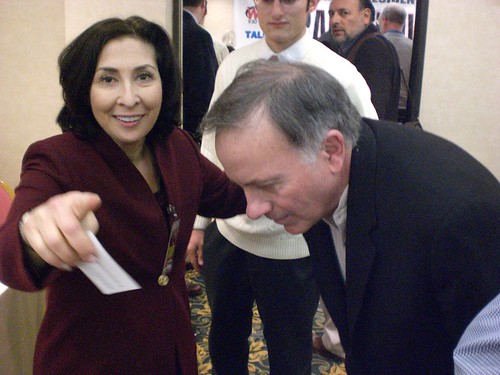
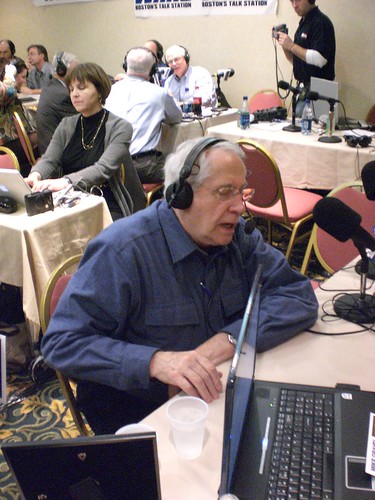
MANCHESTER, N.H. -- Thanks to our friends at Talk Radio News Service, the National Women's Editorial Forum has an inside view of the madness known as radio row here at the Center of New Hampshire Radisson Hotel, where the national and local media have all clustered for coverage of the first-in-the-nation presidential primary.
In two hotel meeting rooms talk radio hosts occupy tables laden with microphones and computers, and representatives from all the campaigns come and make the rounds. Behind me, right-wing radio host Laura Ingraham holds court. At the table next to hers, New Hampshire's own Arnie Arnesen receives her guests. Arnesen was just named as one of the nation's "most valuable progressives" by The Nation magazine.
This morning, the place experienced a major swarm of Hillary Clinton's surrogates, along with representatives from virtually all the presidential campaigns, Democrat and Republican. A few chairs down from me, David Bonior, the former congressman who chairs the John Edwards campaign, is giving an interview to University of New Mexico radio. Over in the corner, Republican candidate Ron Paul is being mobbed by both radio and television folks.
Me, I'm just trying to keep from getting knocked in the head with a mic or a television camera.
--Adele M. Stan
Investing to Re-Energize Ohio
By Amanda Woodrum
There is a gaping hole in Ohio’s economy. At current energy prices, we are sending nearly $20 billion every year out of Ohio and out of our country in order to purchase two-thirds of our coal, 89 percent of our natural gas, and 98 percent of the oil and petroleum products we use.
We currently rank fourth among states for industrial energy use and sixth for total energy consumption. To make our economy more energy independent and reduce our need to purchase expensive and polluting fuels, we should expand Ohio’s clean energy fund. This will allow us to become more energy efficient and to replace some of our polluting energy sources with renewable energy resources such as wind, solar, and biomass, which can be produced domestically.
Eighteen states and District of Columbia are together spending nearly $2 billion for clean energy to help break down existing market barriers to energy efficiency and renewable energy products and services. Why? Because each dollar invested in renewable energy and energy efficiency creates more manufacturing, construction, retail, and service jobs than an equivalent dollar spent on conventional energy. And every public dollar spent for clean energy leverages an additional $3 in related business and consumer investment, according to the American Council for an Energy Efficient Economy.
These clean energy funds, including Ohio’s Advanced Energy Fund, are used to reduce equipment costs for clean energy products through consumer rebates, grants, and low-interest loans; to conduct statewide public-awareness campaigns; to provide incentives for industrial production of clean energy products; and to train workers for the green economy.
Clean energy funds, across the 18 states, range from $2.3 million to $440 million per year. Ohio is near the bottom of that pack. Other industrial states collect more money than Ohio annually in order to jumpstart their economies, Michigan over $66 million, New York $175 million, and Wisconsin over $82 million. Pennsylvania’s governor proposed an $850 million Energy Independence Fund.
The state of Ohio currently collects $5 million each year, through a nine cent surcharge on Ohio electric utility bills, to spend on clean energy projects and services. Compared to the $20 billion we spend on conventional energy purchased from other states and other countries, $5 million seems almost trivial.
The public benefits funds we have spent thus far on clean energy in Ohio indicate the potential for much more far-reaching gains. A little over $5 million in public fund expenditures from Advanced Energy Funds leveraged an additional $21 million in outside investment. Ohio consumers are eagerly using clean energy funds to invest in energy efficiency, solar power, wind power, and biomass equipment. Recently, $5 million in grant funding was also allocated to aid in the creation of two large-scale wind farms to help provide electricity to 45,000 Ohioans.
Ohio’s Advanced Energy Fund should be expanded, made permanent, and used to encourage both the supply of and demand in Ohio for energy efficiency improvements and renewable energy systems. A $0.003 per kilowatt-hour surcharge on energy use, or three-tenths of a cent for every 1000 watts consumed for an hour, would generate an annual fund of over $465 million. To the average residential consumer this would mean a $2.80 increase in their monthly electric utility bill.
A greatly expanded clean energy fund in Ohio could be used to implement a statewide outreach campaign to educate the public on their energy efficiency and renewable energy options, and to provide free energy audits to Ohioans and simple customer rebates for green products such as solar panels. We can also expand Ohio’s clean energy supply chain by providing financial support to potential suppliers of green energy products and services to retool their infrastructure and retrain their workers. We could create a Green Jobs Corps program to provide green employment services and weave together vocational skills training programs, union apprenticeship programs, and recognized pre-apprenticeship programs that create pathways out of poverty.
It’s time for Ohio to get serious about investing in a clean energy economy by creating a strong Advanced Energy Fund.
--------------------------------------------------------------------------------
Woodrum is the Policy Liaison at Policy Matters Ohio, a non-partisan policy research institute. Her recent report on Ohio’s Advanced Energy Fund is on the web at www.policymattersohio.org.
There is a gaping hole in Ohio’s economy. At current energy prices, we are sending nearly $20 billion every year out of Ohio and out of our country in order to purchase two-thirds of our coal, 89 percent of our natural gas, and 98 percent of the oil and petroleum products we use.
We currently rank fourth among states for industrial energy use and sixth for total energy consumption. To make our economy more energy independent and reduce our need to purchase expensive and polluting fuels, we should expand Ohio’s clean energy fund. This will allow us to become more energy efficient and to replace some of our polluting energy sources with renewable energy resources such as wind, solar, and biomass, which can be produced domestically.
Eighteen states and District of Columbia are together spending nearly $2 billion for clean energy to help break down existing market barriers to energy efficiency and renewable energy products and services. Why? Because each dollar invested in renewable energy and energy efficiency creates more manufacturing, construction, retail, and service jobs than an equivalent dollar spent on conventional energy. And every public dollar spent for clean energy leverages an additional $3 in related business and consumer investment, according to the American Council for an Energy Efficient Economy.
These clean energy funds, including Ohio’s Advanced Energy Fund, are used to reduce equipment costs for clean energy products through consumer rebates, grants, and low-interest loans; to conduct statewide public-awareness campaigns; to provide incentives for industrial production of clean energy products; and to train workers for the green economy.
Clean energy funds, across the 18 states, range from $2.3 million to $440 million per year. Ohio is near the bottom of that pack. Other industrial states collect more money than Ohio annually in order to jumpstart their economies, Michigan over $66 million, New York $175 million, and Wisconsin over $82 million. Pennsylvania’s governor proposed an $850 million Energy Independence Fund.
The state of Ohio currently collects $5 million each year, through a nine cent surcharge on Ohio electric utility bills, to spend on clean energy projects and services. Compared to the $20 billion we spend on conventional energy purchased from other states and other countries, $5 million seems almost trivial.
The public benefits funds we have spent thus far on clean energy in Ohio indicate the potential for much more far-reaching gains. A little over $5 million in public fund expenditures from Advanced Energy Funds leveraged an additional $21 million in outside investment. Ohio consumers are eagerly using clean energy funds to invest in energy efficiency, solar power, wind power, and biomass equipment. Recently, $5 million in grant funding was also allocated to aid in the creation of two large-scale wind farms to help provide electricity to 45,000 Ohioans.
Ohio’s Advanced Energy Fund should be expanded, made permanent, and used to encourage both the supply of and demand in Ohio for energy efficiency improvements and renewable energy systems. A $0.003 per kilowatt-hour surcharge on energy use, or three-tenths of a cent for every 1000 watts consumed for an hour, would generate an annual fund of over $465 million. To the average residential consumer this would mean a $2.80 increase in their monthly electric utility bill.
A greatly expanded clean energy fund in Ohio could be used to implement a statewide outreach campaign to educate the public on their energy efficiency and renewable energy options, and to provide free energy audits to Ohioans and simple customer rebates for green products such as solar panels. We can also expand Ohio’s clean energy supply chain by providing financial support to potential suppliers of green energy products and services to retool their infrastructure and retrain their workers. We could create a Green Jobs Corps program to provide green employment services and weave together vocational skills training programs, union apprenticeship programs, and recognized pre-apprenticeship programs that create pathways out of poverty.
It’s time for Ohio to get serious about investing in a clean energy economy by creating a strong Advanced Energy Fund.
--------------------------------------------------------------------------------
Woodrum is the Policy Liaison at Policy Matters Ohio, a non-partisan policy research institute. Her recent report on Ohio’s Advanced Energy Fund is on the web at www.policymattersohio.org.
Thursday, January 03, 2008
Three Reasons to Oppose Cliffside Expansion
 By Alice Loyd
What should North Carolina do in response to the growing effects of global climate change, a statewide health advisory on mercury tainted fish, and an exceptionally serious statewide drought? Apparently the answer for Duke Energy and state regulators is to build a new massive carbon dioxide spewing, mercury emitting, and water-depleting coal burning power plant just west of Charlotte. If built, this 800-megawatt coal-fired unit at Duke’s Cliffside power plant will be the largest coal burning unit ever built in North Carolina.
The answer for people who practice what they preach about environmental responsibility is quite different. These people work for a new energy economy in which officials would not permit Duke to build this proposed coal plant. Here are just three of the reasons not to build:
THE DROUGHT: North Carolina is currently under a severe statewide drought and Governor Easley is urging residents to find creative ways to conserve water. But what isn’t often mentioned is that coal and nuclear power plants are some of the state’s biggest water hogs. If the Cliffside unit is built, it would double the amount of water lost to evaporation at the Duke plant from 10 million to about 20 million gallons -- each day.
To put that number in perspective, the additional 10 million gallons of lost water would be equivalent to the combined water consumption on one day this November by the cities of Lexington, Boone, Nashville, Goldsboro, and Brevard.
The drought is serious enough that Duke and Progress Energy have begun looking at contingency plans in the event there isn’t enough water to run their coal and nuclear plants. Here’s a plan for Duke and Progress: invest in renewable sources of energy like solar and wind power, which are drought-proof.
CLIMATE CHANGE: Duke Energy’s plan for more coal comes just as the overwhelming scientific evidence points to humanity’s impact on global climate change. If built, the new Cliffside unit will annually emit over 6 million tons of carbon dioxide, one of the leading factors in global warming.
State regulators in Washington soundly rejected a plan for a 793 mega-watt coal plant this November because of their concerns about the plant’s emissions. This ruling followed similar recent decisions to halt coal plants in Florida, Kansas, Minnesota, Oklahoma and Texas. These states understand that the addiction to coal power must be kicked. Why doesn’t North Carolina?
MERCURY TAINTED FISH: Coal fired power plants are also the number one source of mercury emissions in North Carolina. Those emissions eventually fall into our waterways and make their way up the fish food chain.
Coincidentally, the state Department of Public Health has issued its largest ever fish consumption advisory based on unsafe levels of mercury found in fish consumed by North Carolinians. Most women and children are urged to avoid eating 22 types of fish due to high levels of mercury contamination. Mercury is particularly dangerous for women of child-bearing age because of the potential for harm to a developing fetus. Unsafe levels of mercury can lead to developmental disabilities and other adverse health effects. Burning more coal in North Carolina will only increase the mercury health risks for mothers and their babies.
In today’s world of technological advances in clean and renewable energy, it is irresponsible to commit this state to decades more coal pollution. Who will take responsibility and protect the people of North Carolina?
Perhaps state regulators at the Division of Air Quality will deny the permit Duke needs before beginning construction of the plant. Perhaps state legislators will pass legislation halting new coal power plants in North Carolina while the state studies the impact of global warming and the drought. Perhaps Governor Easley will use the power of the Governor’s mansion and follow the lead of Kansas Governor Kathleen Sebelius. She wrote the following after Kansas regulators denied a request for a new coal plant in October:
Of all the duties and responsibilities entrusted to me as governor, none is greater than my obligation to protect the health and well-being of the people of Kansas…Instead of building two new coal plants, which would produce 11 million new tons of carbon dioxide each year, I support pursuing other, more promising energy and economic development alternatives.That sounds like real leadership. North Carolina needs our state’s decision makers to stand up for the public good and break our addiction to dirty energy by saying no to Duke Energy’s plans to expand their Cliffside coal plant.
--------------------------------------------------------------------------------
Loyd is the director of North Carolina Interfaith Power & Light, a project of the North Carolina Council of Churches.
Wednesday, December 26, 2007
The Jamie Lynn Spears Generation
 By Cristina Page
(Click here to listen to a Public Service Announcement distributed by American Forum on the effects of abstinence-only education and the rise of premature parenthood and pregnancy rates among teenagers.)
The Spears family can't be shocked by much these days, not with Britney in every tabloid. Still the recent news seemed to unsettle them. Their 16-year-old daughter Jamie Lynn is pregnant. And while no bad news is unprofitable for the Spears (it is rumored Jamie Lynn, a TV star in her own right, was paid one million dollars to break the news in OK! Magazine), this particular note of fame does appear to have taken the family aback. ("I was in shock. I mean, this is my 16-year-old baby," her mother told OK!) It seems that no matter how well-to-do, (or bizarre) the family, it's always a tragedy to have one's child's adolescence taken away by pregnancy. While Jamie Lynn Spears is not your average teen, her situation is becoming a more common experience for many girls of her generation: premature parenthood.
A Center for Disease Control (CDC) report released this month reveals that in 2006 there was a dramatic rise in teen births among 15 to 19 year olds in the United States bringing to a grinding halt a steady 14-year decline. In fact, Jamie Lynn's situation exemplifies a reversal of many positive trends that began in the 1990s. Specifically there was a steep drop in abortion and unwanted pregnancy rates. During this period even sexual activity among high school students declined significantly. And those teens who were having sex -- as would an average of half of them would before graduating high school - were more likely to use protection.
Now these gains are slowing or reversing. Sadly, these reversals seemed inevitable. After all, since 2000 we have turned away from using every strategy that the previous decade proved effective.
Today's teens are the victims of a one billion dollar social experiment: The national implementation of the abstinence until marriage policy. Like the "Just Say No" to drugs campaigns of the Reagan years, it too has been a colossal failure.
Abstinence-only programs have not only failed to convince kids not to have sex, but have led many not to use contraception. To scare teens away from sexual activity, abstinence-only programs focus on the dangers of sex. If contraception is ever mentioned it is to highlight (and exaggerate) its failure rates. If a girl is told that even if her boyfriend uses a condom she'll get pregnant once every seven times -- as the popular abstinence program "Choosing the Best Way" instructs -- the incentive to use one dissipates.
Those promoting abstinence-only, mainly religious political groups, say parents should have the right to teach children according to their beliefs. What the same groups fail to mention is that the vast majority of parents -- 93 percent according to a 2004 Kaiser Family Foundation poll -- want their teens taught comprehensive sex ed, including accurate information about protection from pregnancy and disease. If there is a prevailing belief among parents it is decidedly anti-abstinence-only education. They're in good company too: All mainstream organizations of health professionals that deal with young people strongly criticize federal support for current abstinence programs. These include the American Public Health Association, the American Medical Association, the American Academy of Pediatrics, the American Psychological Association, and the Society for Adolescent Medicine. Last month 10 of the top experts in the fields of adolescent sexual and reproductive health advised Congress to completely de-fund abstinence-only programs because they withhold "potentially life-saving information from youth."
The toll of withholding potentially life-saving information is becoming tragically evident. In the states where the abstinence-only approach is more likely to be used disease is up. School districts in the South are five times more likely than in the Northeast to teach only abstinence. Today, the southern states have the highest rate of new HIV/AIDS infections, the highest rate of STDs, as well as the highest rate of teen births. While over the last decade other regions have made major strides in decreasing or stagnating HIV infection rates, according to the CDC the South accounts for 45 percent of all new cases.
Many states are realizing that instilling ignorance about sex and protection in our teens is the real moral violation. Teens need accurate information in order to make important life decisions. That is why, to date, 15 states have refused federal money for abstinence-only funding. Parents in the remaining 35 states must demand that their governors and statehouses reject federal grants for these ineffective and dangerous programs too. It's the only time just saying no might actually work.
----------------------------------------------------------------
Page is the author of How the Pro-Choice Movement Saved America: Freedom, Politics and the War on Sex and spokesperson for BirthControlWatch.org
Subscribe to:
Posts (Atom)